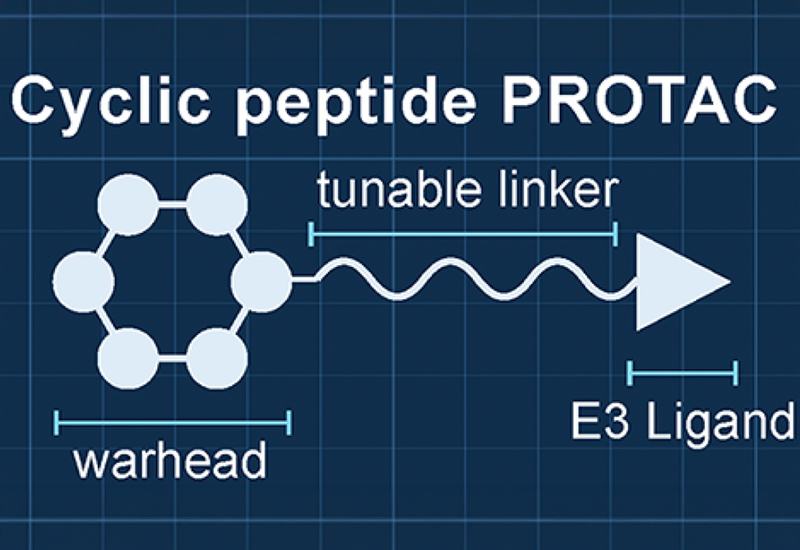
Targeted protein degradation offers a catalytic alternative to occupancy-driven inhibition, but most proteolytic-targeting chimeras, PROTACs, depend on small-molecule warheads and therefore cannot access proteins whose binding interfaces lack druggable pockets. Hypoxia-inducible factor 1, HIF-1, is a canonical example: its α/β heterodimerization surface drives tumor adaptation to low oxygen and promotes therapy resistance, yet decades of drug-discovery effort have not yielded a clinical inhibitor. Cyclic peptides can engage such flat, featureless interfaces, and PROTAC-based degradation of HIF-1α would suppress an entire transcriptional program rather than block a single node. The obstacle is synthetic, as cyclic peptides have no established route to bifunctional degrader architecture, and the biology adds a further complication: under the severe hypoxia that pervades tumor cores, HIF-1α is continuously resynthesized, potentially outrunning any degrader regardless of potency.
Researchers in the Tavassoli Group at the University of Southampton, published in J. Am. Chem. Soc., addressed both problems systematically. Starting from a SICLOPPS-derived cyclic peptide inhibitor of the HIF-1α/HIF-1β protein–protein interaction, the team developed modular bifunctional amino acid building blocks that embed both a variable-length linker and the VHL-recruiting ligand VH032 in a single Fmoc-protected residue compatible with standard SPPS. Attaching these building blocks at a solvent-exposed position identified by structure–activity relationship analysis, then benchmarking them across a panel of cyclic peptide PROTACs, revealed that linker attachment geometry matters as much as length. The lead compound forms a productive HIF-1α–VHL ternary complex and achieves low-micromolar degradation in HCT116 colorectal carcinoma cells under chemically induced hypoxia. Critically, degradation fails at 1% oxygen not because the degrader loses target engagement, but because HIF-1α resynthesis accumulates faster than proteasomal clearance flux can remove it, a kinetic ceiling revealed by cycloheximide rescue experiments.
These findings reframe a general principle for PROTAC drug discovery: against stress-stabilized, rapidly replenished targets, degrader potency alone cannot overcome biology operating at the resynthesis rate. The modular amino acid building blocks provide a direct SPPS-compatible route for converting any cyclic peptide hit into a CP-PROTAC, extending targeted degradation to protein–protein interaction targets that small molecules cannot address. Full degradation profiles, proteome-wide selectivity data, and the complete linker scope are available in the original publication.