Chemically induced dimerization, CID, systems are indispensable tools for switching cellular processes on and off with a small molecule. The workhorse of the field, the rapamycin–FKBP–FRB system, works well but brings an unwanted complication: rapamycin is an immunosuppressant that also engages endogenous proteins, producing off-target effects in vivo. Workarounds have relied on derivatizing rapamycin, transplanting plant-derived CID systems into mammalian cells, or using directed evolution and phage display to engineer binding partners for existing ligands. Each strategy inherits constraints from the natural starting material, and the universe of accessible ligand–protein pairs stays narrow. What the field needs is a route to CID systems designed from the ground up, where both the chemical inducer and its cognate protein are engineered together with no natural template to constrain them.
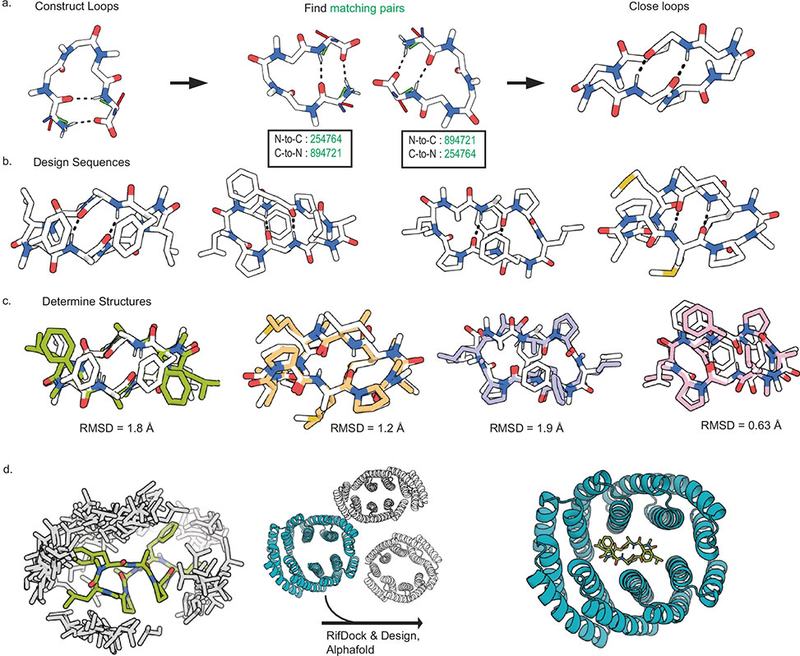
Researchers in the Baker Lab at the University of Washington, published in Nature Communications, reasoned that structured, membrane-permeable macrocycles with large exposed surface areas could serve as ideal de novo CID ligands, provided a matching protein could be designed to recognize them. The team generated libraries of backbone-cyclized peptides by identifying pairs of hydrogen-bonding loops whose terminal geometry matched, fusing them into closed rings in which all backbone amides were either engaged in transannular hydrogen bonds or N-methylated, satisfying every polar group and favoring membrane permeability. RosettaFastDesign then assigned sequences permitting both L and D amino acids, and crystal structures of four designs confirmed close agreement with computational models. One design, MC1, carries internal C2 symmetry, a property the team exploited to simplify the protein-design problem: a homodimeric binding protein was sufficient. Placing MC1 into the central cavities of de novo-designed helical repeat homodimers via RIFdock, followed by interface redesign and AlphaFold 2 filtering, yielded CID7, a homodimer that binds MC1 with a KD of 36 nM and whose co-crystal structure matches the design model with a Cα RMSD of 0.97 Å.
In mammalian cells, MC1 drives measurable reconstitution of a split reporter and reverses cleanly upon ligand washout, validating the system as a tunable switch. Because both the ligand and the protein were designed computationally with no natural scaffold, the framework is in principle extensible to a large family of orthogonal CID pairs, pointing toward simultaneous, independent control of multiple cellular pathways for synthetic biology and adoptive cell therapy. The full design methodology and experimental characterization await in the original publication.