Dropout Finds Target

Reflecting work in the Tavassoli Lab

Published here September 23, 2026

Identification of Antibacterial Cyclic Peptides with a High-Throughput Cell-Based Dropout Screen

Leonie M. Windeln, Lewis W. Mitchell, Agnieszka B. Wisniewska, Alexander McDermott, Scott S. Walker, Abbas M. Walji, and Ali Tavassoli

J. Am. Chem. Soc. 2026, 148, 32451–32460. https://doi.org/10.1021/jacs.6c09188

View Original Publication


Antibiotic discovery has long depended on positive-selection screens against predefined protein targets, a logic that narrows the search space and leaves genuinely novel vulnerabilities unexplored. Cyclic peptides are well suited to intracellular targets, and genetically encoded libraries produced by split-intein circular ligation of peptides and proteins, SICLOPPS, can generate millions of members expressed one-per-cell inside living bacteria. Yet connecting a phenotypic antibacterial hit to its intracellular target has remained a persistent bottleneck, and distinguishing genuine dropout sequences from sequencing noise across a library of millions is a combinatorial problem that existing motif-search tools were not built to solve.

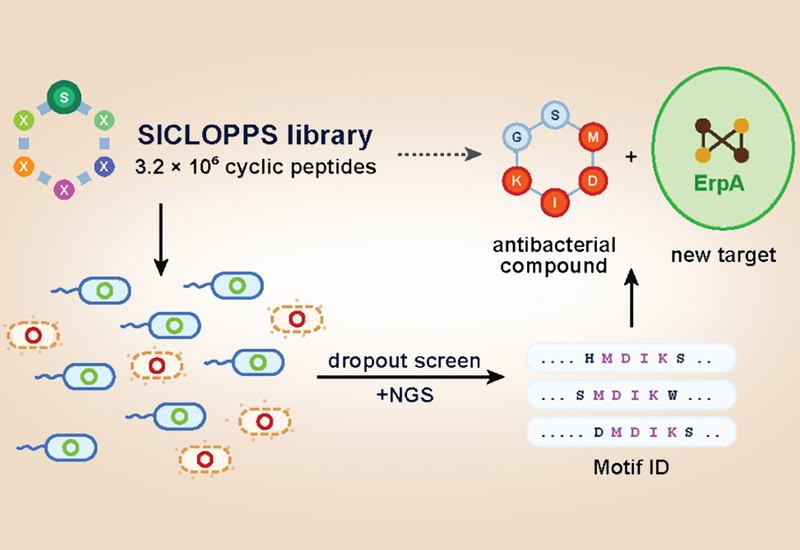
Researchers in the Tavassoli Group at the University of Southampton, in collaboration with researchers at Merck & Co. Inc., published in J. Am. Chem. Soc., reasoned that flipping the selection logic could address both problems at once. Their dropout screen pairs a SICLOPPS library of 3.2 million cyclic hexapeptides with next-generation sequencing of the surviving bacterial population: sequences whose encoded cyclic peptides harm the host are depleted, and their absence is the signal. To separate genuine dropouts from sampling noise, the team developed a matrix-based pharmacophore clustering framework that counts the abundance of every possible di-, tri-, and tetrapeptide motif before and after induction and ranks motifs by fractional depletion. Tetrapeptide resolution proved critical: the MDIK motif emerged as the top-ranked hit, and a gradient of dropout signal across the flanking residues of cyclo-SMDIKG independently validated MDIK as the active pharmacophore. Target identification combined a biotinylated pull-down probe with genetic rescue experiments, and only ErpA, an A-type iron–sulfur cluster carrier essential for both aerobic and anaerobic respiration in E. coli, conferred rescue; microscale thermophoresis confirmed direct binding with a KD of 4.3 ± 1.0 μM.

ErpA had not previously been targeted by any reported inhibitor, illustrating how a target-agnostic dropout strategy can surface vulnerabilities that hypothesis-driven campaigns miss. The pharmacophore-clustering framework applies equally to enrichment-based screens, and the authors identify improved potency and outer-membrane permeability as the next engineering challenges for the cyclo-SMDIKX scaffold.


Author

Dr. Lewis Mitchell holds an MBiolSci in biochemistry and microbiology from the University of Sheffield. Following a year as a placement student at AstraZeneca in the protein science and high-throughput screening departments where his passion for drug discovery began, he completed a Ph.D. in chemistry at the University of Southampton in the Tavassoli lab. His doctoral research focused on the application of genetically encoded cyclic peptide libraries in the discovery and development of novel antibiotics to combat the threat of antibiotic resistance. Lewis currently works as a scientist at Sygnature Discovery, working with diverse clients to deliver assay development and high-throughput screening campaigns to accelerate cutting-edge drug discovery across a range of therapeutic areas, presently in the field of neuroscience.

Author

Agnieszka Beata Wisniewska completed her BSc and Master’s by Research in Medicinal Chemistry at the University of Salford, where she worked on the design and synthesis of small‑molecule non‑sugar mimetics targeting GAG receptors, developing a strong foundation in organic synthesis and ligand design. She subsequently joined the University of Southampton to pursue her Ph.D. in the Tavassoli group, where she transitioned from synthetic medicinal chemistry into chemical biology, protein science, and biophysics. Her doctoral research focuses on the rational design, synthesis, and biophysical evaluation of small‑molecule inhibitors. During this work, she developed expertise in assay development, protein–ligand biophysics, and structural analysis, employing techniques such as microscale thermophoresis, ITC, SPR and cellular assays. In 2026, Agnieszka joined the National Physical Laboratory, NPL, where her research centres on protein spectroscopy and the application of advanced biophysical methods to investigate protein structure, stability, and interactions. Her scientific interests span spectroscopic analysis of biomolecules, structure‑guided ligand design, and measurement‑driven approaches that support innovation in health and life sciences.

Dropout Finds Target

Author

Dr. Leonie Windeln earned her Ph.D. in chemistry from the University of Southampton in 2024, having carried out her doctoral research there from 2019 under the supervision of Prof. Ali Tavassoli. Her thesis, "Screening genetically encoded cyclic peptide libraries to identify novel antibiotic precursors," used split-intein circular ligation of peptides and proteins, SICLOPPS, libraries for antibiotic discovery and included establishing a next-generation sequencing, NGS, workflow that enables rapid hit identification in targeted SICLOPPS screens. As a postdoctoral researcher at Southampton, she collaborated with Prof. John Essex and Prof. Jeremy Frey to study the structure-function relationships of conotoxins and their binding proteins, and initiated research into developing de novo protein binders of these peptides. Since 2025, she has been working at T-Cypher Bio, where she contributes to developing immune engagers as part of the computational biology team.