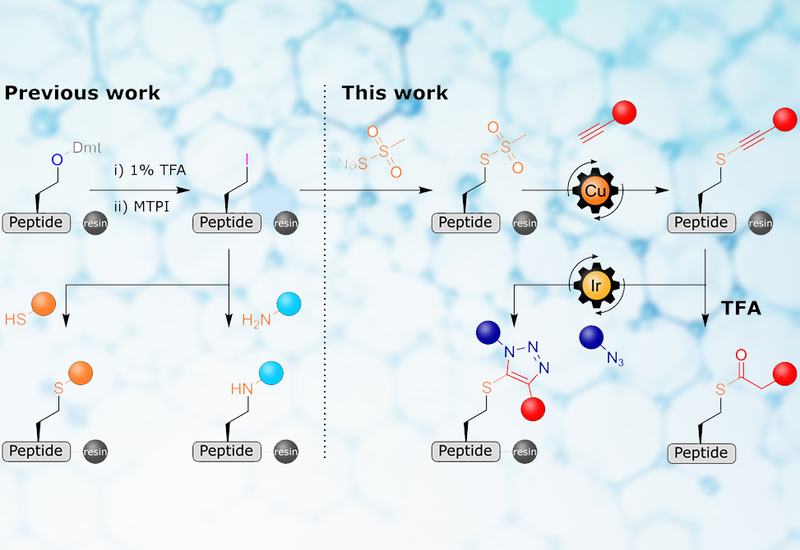
Generating large libraries of non-canonically modified peptides demands synthetic routes that are both modular and compatible with complex sequences. On-resin late-stage functionalization allows parallel, automated diversification after the peptide chain is already assembled, but existing methods typically introduce a single modification at one functional site while all others remain protected. Achieving two independent, chemically distinct modifications at the same position, on a resin-bound peptide of realistic complexity, has remained out of reach. The gap matters because drug discovery campaigns increasingly require peptides decorated with multiple non-natural elements, including reactive handles, fluorescent tags, and pharmacophores, all in a single synthetic pass.
Researchers in the Thomas Lab at Heidelberg University, published in Angewandte Chemie International Edition, built the dual-modification platform on a thiosulfonate pivot. Starting from a resin-bound homoserine residue, on-resin iodination followed by nucleophilic substitution places a methylthiosulfonate group at the desired position. Copper-catalyzed S-alkynylation converts that thiosulfonate into a thioalkyne: upon acidic cleavage it collapses to a peptide thioester, a reactive handle central to native chemical ligation, but on the resin it can first undergo iridium-catalyzed azide-alkyne cycloaddition, IrAAC, delivering regioselective 1,5-triazoles. The key design insight is that spatial separation of thiosulfonate groups on the solid support suppresses the disulfide side reactions that plague solution-phase S-alkynylation, allowing a broader alkyne scope, including aliphatic alkynes that routinely fail in solution. Switching the base to Cs2CO3 and the copper source to Cu(OTf)2 proved decisive for aliphatic substrates, and the subsequent IrAAC step tolerates polar, hydrophobic, and biomolecule-bearing azides alike.
The practical reach of the method becomes clear in a structure-activity relationship study of peptide inhibitors targeting dengue virus protease, DENVpro. A library of triazole-containing variants assembled via the dual-modification route yielded one compound with an IC50 around 10 μM, a 20-fold potency gain over the lead with improved aqueous solubility. The ability to thread structurally diverse alkyne and azide fragments through a single unprotected sequence position, without pre-installing click handles during chain assembly, positions this platform as a practical tool for peptide library synthesis targeting difficult protein-protein interaction surfaces. Full substrate scope, optimization data, and NMR characterization of the triazole regiochemistry are in the original publication.