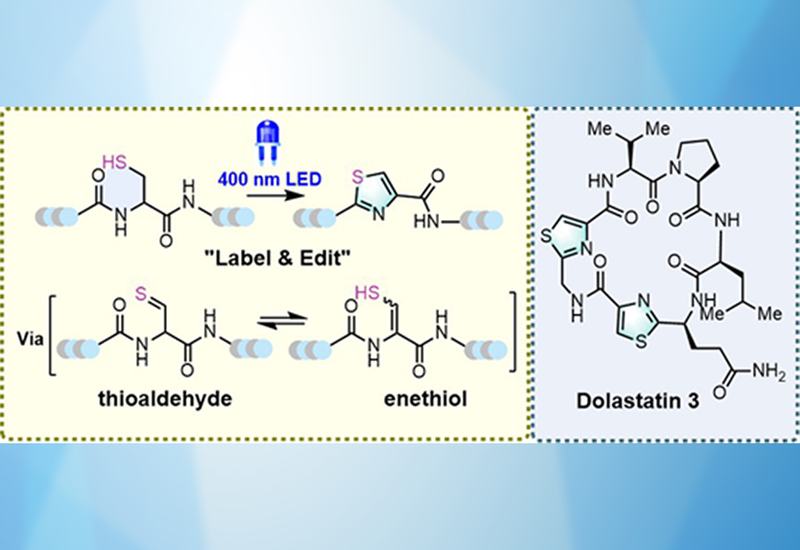
Peptide backbone editing offers a direct route to structural novelty, but, as the authors observe, "chemical approaches for selective backbone editing remain scarce." The difficulty is fundamental: distinguishing one specific amide bond in a peptide sequence from all the others resists straightforward chemical logic. Nature resolves this problem enzymatically, using dedicated biosynthetic machinery to convert cysteine residues into thiazole rings with extraordinary selectivity. Because every atom of the resulting thiazole originates from the cysteine residue itself, the transformation is traceless, leaving no chemical scar. The appeal of reproducing this transformation chemically is therefore high, yet no synthetic method had been reported to mimic it.
Researchers in the Xian Group at Brown University, published in the Journal of the American Chemical Society, developed a traceless "label-and-edit" strategy that converts cysteine residues into thiazole rings via selective thiol labeling, photoinduced intermediate generation, and intramolecular cyclization. 2-Bromoacetophenone first alkylates the cysteine thiol site-specifically, installing a phenacyl handle on the backbone. Irradiation at 400 nm then triggers Norrish type II cleavage, releasing acetophenone and generating a cysteine-derived thioaldehyde that equilibrates with enethiol isomers; DFT calculations place the enethiol 7.12 kcal/mol below the thioaldehyde, making it the dominant species in solution. The Z-enethiol isomer then adds intramolecularly to the adjacent amide carbonyl, and dehydration closes the thiazole ring. Acid may also facilitate tautomerization and increase the electrophilicity of the amide carbonyl toward cyclization. The full protocol requires 16 h of irradiation followed by heating at 50 °C for 12 h in DMSO under argon.
The authors demonstrate the strategy on unprotected glutathione and on octreotide, then apply it to late-stage backbone modification of a precursor that delivers dolastatin 3 upon deprotection, matching reported NMR spectra. Previous routes to dolastatin 3 required thiazole-containing building blocks needing 4 to 7 steps to prepare; the new approach builds the ring directly at the cysteine site. The authors propose that cysteine-derived enethiols serve as versatile intermediates for late-stage diversification and functional optimization of peptide and biomolecular structures.