Ribosomally synthesized and post-translationally modified peptides, RiPPs, that carry biaryl cross-links sit at an attractive intersection of conformational rigidity, metabolic stability, and membrane permeability. Cytochrome P450 enzymes forge these Tyr–Trp and Trp–Trp carbon–carbon bonds in vivo with elegant efficiency, but the biosynthetic route imposes strict constraints: only electron-rich native residues participate, enzyme specificity locks in the peptide sequence, and heterologous production rarely delivers more than single-digit milligrams of material. Chemical synthesis has cracked individual targets, but each required a bespoke route, leaving a broad, medically interesting chemical space effectively inaccessible.
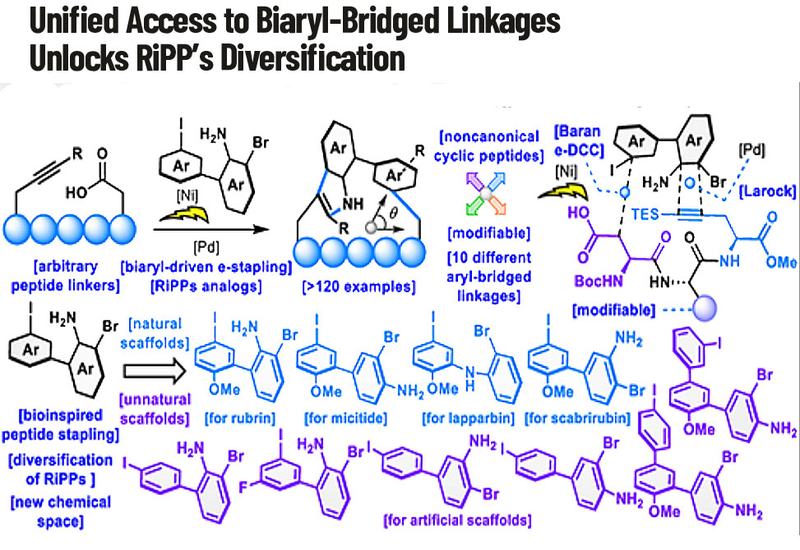
Researchers in Hugh Nakamura's Lab at The Hong Kong University of Science and Technology, published in J. Am. Chem. Soc., combined two complementary reactions into a unified "e-stapling" platform. The first step uses nickel-catalyzed electrochemical decarboxylative cross-electrophile coupling to attach a preformed biaryl unit to an aspartate-derived redox-active ester within a peptide linker, forming the critical C(sp³)–C(sp²) bond under mild conditions and on gram scale. The resulting linear precursor then undergoes palladium-catalyzed Larock macrocyclization to close the strained biaryl-bridged ring. The researchers identified two complementary assembly sequences: one privileging rapid exchange of biaryl units across a fixed peptide linker, the other privileging rapid exchange of amino acid sequences around a fixed biaryl unit. Together they enabled systematic access to ten distinct biaryl and triaryl cross-linking motifs, covering four naturally inspired scaffolds drawn from rubrin, micitide, lapparbin, and scabrirubin CB-4, as well as six artificial variants including fluorine-bearing and triaryl architectures not accessible by enzymatic routes. The platform also broke the ring-size constraint inherent to enzyme-pocket geometry, delivering cyclic peptides across a range of residue counts as single stereoisomers.
The scope translates directly into medicinal chemistry opportunity. A library of more than 120 RiPP derivatives was assembled, and structure–activity relationship studies on cihunamide B analogs identified compounds with antibacterial activity against methicillin-resistant Staphylococcus aureus and Bacillus subtilis. For peptide scientists pursuing biaryl-bridged scaffolds as drug leads, the full synthetic details, substrate scope, and biological data are in the paper.