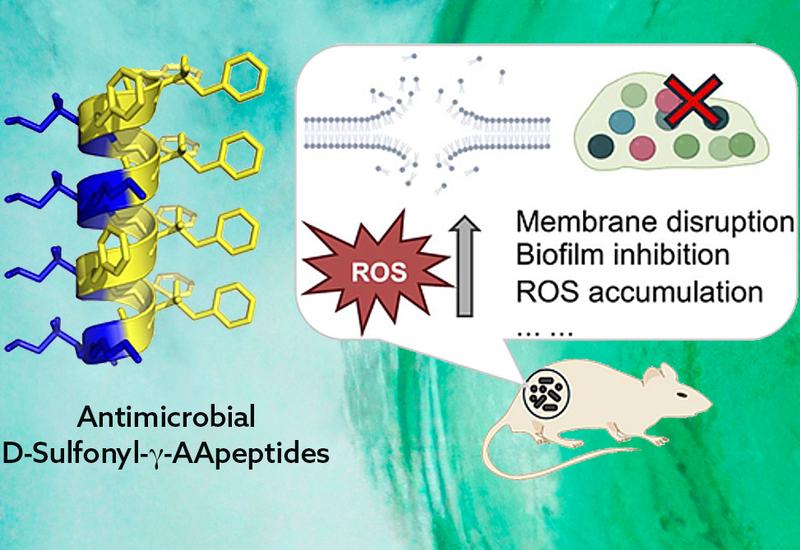
Natural antimicrobial peptides, AMPs, kill bacteria by physically disrupting membranes rather than hitting a single protein target, making resistance development far less likely than with conventional antibiotics. Yet the same properties that make them potent, cationic amphipathicity and conformational flexibility, also drive proteolytic degradation, hemolytic toxicity, and poor pharmacokinetics, and no natural AMP has navigated that gauntlet to reach clinical use. Peptidomimetic scaffolds that enforce a preorganized amphipathic helix could preserve the membrane-targeting logic while sidestepping those liabilities, but translating that concept into compounds that are simultaneously potent, selective, stable, and active in vivo has proven difficult. Global physicochemical descriptors such as net charge and hydrophobic fraction turn out to be poor guides: two peptides with identical compositions but different side-chain layouts can behave entirely differently, and without a rigid scaffold that maps those positions precisely, rational optimization stalls.
Researchers in the Cai Group at Purdue University, published in J. Med. Chem., reasoned that the four-faced helical topology of D-sulfonyl-γ-AApeptide foldamers could resolve this problem. Because residues spaced four positions apart project onto the same helical face, the scaffold encodes hydrophobic and cationic functionalities with spatial precision that conventional α-helices, which disorder in aqueous solution until membrane contact, cannot offer. The team synthesized a library of fifteen 8-mer right-handed foldamers, holding sequence length constant while systematically varying the distribution of phenylalanine-like hydrophobic groups and lysine-derived cationic groups across the two topologically distinct helical surfaces. Structure–activity analysis showed that neither net charge nor hydrophobic content alone predicted potency; instead, the precise segregation of functional residues on each face governed both antibacterial activity and membrane selectivity. That topology-driven optimization converged on lead compound AM10, which elicited no measurable increase in minimum inhibitory concentration against E. coli or MRSA over 14 to 16 serial passages, in sharp contrast to ciprofloxacin under the same conditions.
AM10 retained full activity after 24-hour incubation in serum and Pronase and reduced bacterial burden in a neutropenic mouse MRSA thigh-infection model. The broader significance lies in the scaffold itself: the four-faced helical topology of sulfonyl-γ-AApeptides offers a modular platform for encoding amphipathic patterns that cannot be rationally accessed with flexible natural sequences, opening a systematic route toward next-generation peptidomimetic antibiotics with engineered selectivity and built-in proteolytic stability.