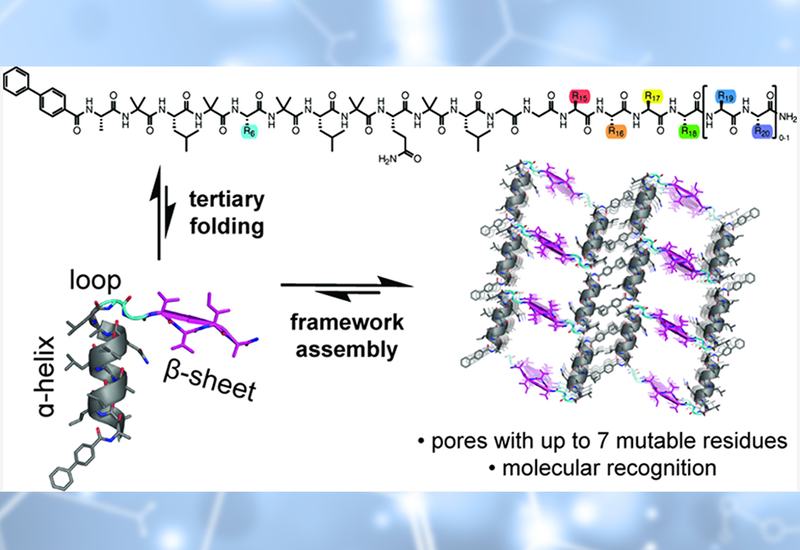
Tertiary structure, the defining architectural feature of proteins and the primary source of their function, has long been considered out of reach for short peptides. Theory and experimental observations both suggest that globular tertiary folding becomes highly unfavorable below roughly 30 amino acids because the stabilizing energy available from intramolecular interactions is insufficient to overcome the entropic cost of folding. Some peptides near 20 residues do achieve tertiary structure, but those examples dedicate nearly all residues to building a stabilizing hydrophobic core, leaving little room for active sites. Self-assembly, leveraging intermolecular stabilization, had been proposed as an alternative route, yet achieving this with very short peptides remained unanswered. A further obstacle is mutational robustness: amino acid substitutions in short peptide frameworks tend to produce entirely different topologies, undermining systematic pore engineering.
Researchers in the Nguyen Group at the University of Illinois Chicago, published in the Journal of the American Chemical Society, reasoned that porous crystalline framework assembly could supply the missing stabilization through lattice energy rather than intramolecular contacts alone. A key geometric insight drove the design: the approximately 8 Å spacing between π-π stack pairs in the UIC-11-BIF framework is close to the repeat distance of antiparallel β-sheets, roughly 9.5 Å, making it feasible to swap the π-stacking unit for a β-strand while preserving the overall lattice. The resulting helloB framework supports an α-β tertiary fold in peptides of only 15 to 19 amino acids. Circular dichroism confirms that the peptide is only partially α-helical with no β-sheet character in solution, so the solid-state crystal lattice itself drives folding into the αβ tertiary structure rather than capturing a pre-formed fold.
The authors conclude that cooperative framework assembly can generate protein-like structure and function in peptides previously thought too short to support it. The large number of mutable pore-facing positions accommodates hydrophobic residues, reactive nucleophiles, acids, and hydrogen-bond donors and acceptors without protecting groups, opening routes to biocatalytic and bioinspired materials. Full binding data, crystal structures, and mutational scope are reported in the paper.