Folding by Design

Reflecting work in the Hemu Lab

Published here September 18, 2026

Conformation-Guided Disulfide Pairing Enables Efficient Folding of Disulfide-Rich Peptides

Jiarong Mo, Shuo Pang, Zeyu Zhang, Mingming Zhen, Yaqin Liu, Yimei Zou, Junchen Wu, Xinya Hemu

Angew. Chem. Int. Ed. 2026, e2924489. https://doi.org/10.1002/anie.2924489

View Original Publication


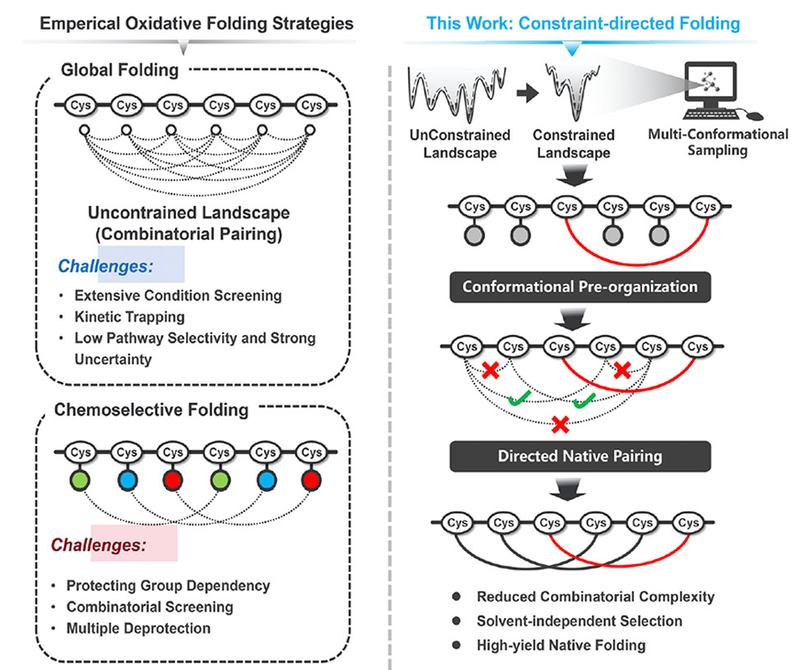
Peptides stabilized by three or more disulfide bonds sit at the heart of some of biology's most potent molecules, from venom toxins and antimicrobial defensins to clinically approved drugs such as ziconotide and linaclotide. Yet the very architecture that makes disulfide-rich peptides, DRPs, so pharmacologically useful also makes them synthetically punishing. In the cell, protein disulfide isomerase shepherds cysteine thiols toward their correct partners; outside the cell, chemists rely on empirical solvent screening, stepwise chemoselective protection schemes, or direct oxidation, all of which treat disulfide formation as a combinatorial problem and ignore how the peptide chain moves while those bonds are forming. The result is a persistent mixture of misfolded isomers and kinetic traps that resist simple optimization.

Researchers in the Hemu Lab at China Pharmaceutical University, published in Angewandte Chemie International Edition, reasoned that oxidative folding and conformational change are bidirectionally coupled: a disulfide formed early does not merely cross-link two cysteines, it reshapes the energy landscape for every subsequent pairing event. To test this, they ran all-atom molecular dynamics simulations of the spider-toxin-derived peptide mGpTx-1, constraining each of its three native disulfide bonds in turn and tracking how the remaining free cysteines redistribute in space. Pre-forming the CysIII–CysVI bond collapsed the conformational ensemble into a single dominant low-energy basin matching the native structure, while native cysteine pairs closed within 0.5 nm and non-native combinations separated beyond 1 nm. Crucially, this pre-organizing effect held across a wide range of solvent conditions, showing that topological constraint outweighs solvent choice as a folding determinant. Translating the prediction into a sequential one-pot workflow, the team used a Trt/Acm orthogonal protection scheme to pre-form the simulation-identified disulfide, then triggered closure of the remaining bonds in a single Pd(II)/DTC step.

Applying the same simulation-guided logic to six additional peptides spanning venom toxins, cyclotides, and topologically distinct clinical candidates demonstrated broad transferability, delivering HPLC conversions of 57–93% across this structurally diverse set. The approach reframes DRP oxidative folding as a design problem rather than an empirical one, offering peptide chemists a rational entry point for tackling complex disulfide architectures without extensive solvent or protecting-group screening.


Author

Junchen Wu is a Professor at the Institute of Innovative Drug, China Pharmaceutical University, Nanjing, China. He received his Ph.D. from Fudan University in 2009 and subsequently conducted postdoctoral research at the University of Duisburg-Essen, Germany, as an Alexander von Humboldt Fellow. He also served as a visiting researcher at the University of California, Berkeley. His research focuses on the design, screening, and synthesis of therapeutic peptides, with particular interests in peptide drug development and technologies for large-scale peptide production. He has authored or co-authored more than 56 publications and patents, and is the recipient of the Outstanding Youth Award and the Achievement Award of the Decade from Peptide Alliance Of China.

Author

Xinya Hemu is a Professor at the School of Traditional Chinese Pharmacy, China Pharmaceutical University. She received her BS and Ph.D. degrees from Nanyang Technological University in Singapore and completed her postdoctoral training with Professor James P. Tam on peptide chemistry. Her research focuses on the discovery and construction of constrained therapeutic peptides and the development of enabling biocatalytic technologies through an integrated platform combining AI-assisted design, high-throughput screening, and structure-guided optimization. With a particular interest in peptide ligation, her group has established one of the most comprehensive collections of peptide asparaginyl ligases, PALs, and developed engineering strategies that expand their applications in peptide synthesis, macrocyclization, and bioconjugation. She has published over 30 peer-reviewed articles and was recognized with the Young Peptide Scientist Award from the Chinese International Peptide Society.

Folding by Design

Author

Jiarong Mo received his M.Sc. degree in Natural Medicinal Chemistry from China Pharmaceutical University under the supervision of Professor Xinya Hemu. His research focuses on peptide chemistry, computational modeling, and enzyme engineering, with an emphasis on the design, synthesis, and functional regulation of bioactive peptides. During his graduate studies, he developed computational and experimental approaches for peptide folding and modification, with a focus on conformation-guided disulfide pairing strategies for disulfide-rich peptides. He has also explored molecular dynamics–assisted design of ion channel–modulating peptides and enzyme engineering. His future research interests lie in integrating molecular simulations, computational design, and experimental validation to advance functional peptide discovery and optimization, with a particular interest in emerging AI-driven approaches for molecular design.