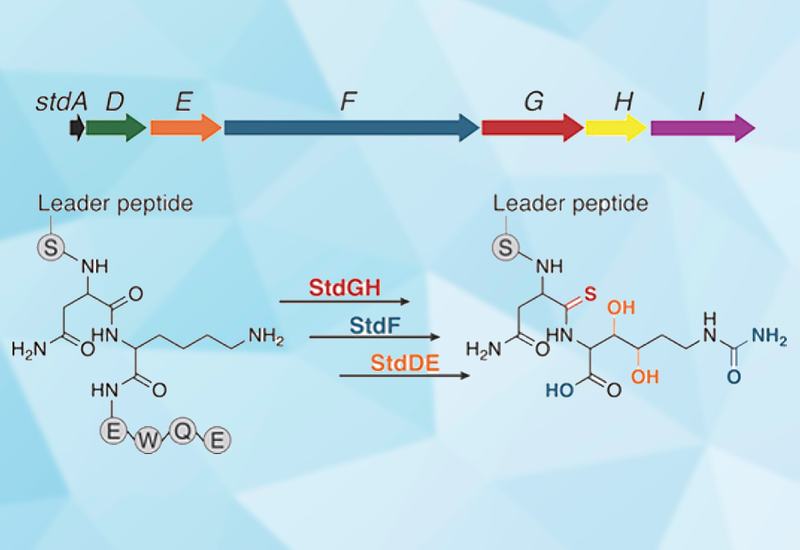
Multinuclear nonheme iron oxidative enzymes, MNIOs, have proven capable of a wide range of unusual post-translational modifications on ribosomally synthesized and post-translationally modified peptides, RiPPs, acting on cysteine, phenylalanine, asparagine, and aspartic acid residues. Yet the full substrate range of the family remains unclear, and large swaths of the MNIO sequence similarity network carry no functional annotation. The challenge in expanding that range is not simply finding new gene clusters: it requires pairing each MNIO with its cognate partner protein, identifying the correct substrate peptide from among conserved precursor sequences, and establishing which co-encoded enzyme acts first. Without that ordered reconstitution, the chemistry of any new modification remains invisible.
Researchers in the Rosenzweig Lab at Northwestern University, published in J. Am. Chem. Soc., used genome mining of thermophilic bacteria to identify an MNIO-containing biosynthetic gene cluster, the std cluster, from Streptomyces thermodiastaticus JCM 4840, whose precursor peptide StdA carries a conserved SNKEWQE core motif not found in any characterized MNIO pathway. Working entirely in vitro, the team reconstituted three enzymes in sequence. The YcaO–TfuA pair StdGH thioamidates the asparagine backbone and must act first, because StdF later removes the C-terminal EWQE follower peptide that StdGH requires. StdF is itself bifunctional: its NodU-like carbamoyltransferase domain transfers a carbamoyl group to the ε-amino group of lysine to produce the nonproteinogenic amino acid homocitrulline, Hcit, while its fused peptidase domain excises EWQE. Only after both modifications does the partner–MNIO complex StdDE accept the substrate, installing two hydroxyl groups at the β- and γ-carbons of Hcit to produce dihydroxyhomocitrulline. The bis-hydroxylated species appears as the dominant product within five minutes, with no monohydroxylated intermediate detectable, consistent with a processive mechanism.
The std cluster establishes that Hcit, a modification long associated exclusively with pathological protein carbamylation in humans, can serve as a programmatically installed RiPP building block, and that MNIOs can hydroxylate nonproteinogenic amino acid substrates. Both findings extend the known catalytic scope of their respective enzyme families and add a new class of YcaO–TfuA-modified RiPPs. The biological activity of the mature product remains under investigation, making the full paper essential reading for groups working at the intersection of RiPP biosynthesis, iron enzyme chemistry, and natural product discovery.