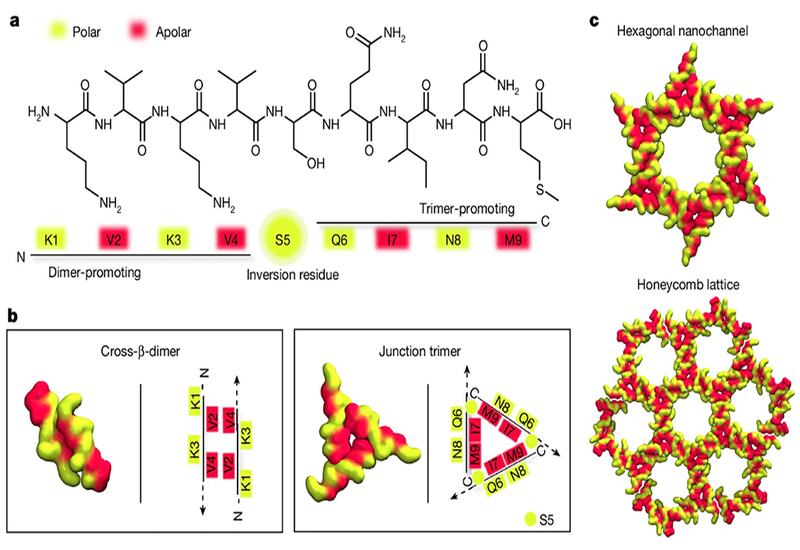
Designing peptides that self-assemble into geometrically defined porous nanoarchitectures has proved difficult at short sequence lengths, where the information density needed to specify both axial propagation and lateral patterning is severely compressed. Without reliable sequence-to-lattice rules, the field has lacked a rational path from minimal peptides to multichannel materials with controlled topology, and the molecular logic governing how discrete side-chain interactions could direct supramolecular tiling at the nanoscale has remained unresolved.
Researchers in the Landfester Group and the Weil Group at the Max Planck Institute for Polymer Research, published in Nature, demonstrate that minimal nine-residue peptides can encode discrete lateral interaction motifs that generate hexagonal pores and hierarchically tile into multichannel nanofibrils with defined topology. The lead peptide, DILT1, forms highly ordered fibrils adopting two principal structural isomorphs: a single-channel hexagonal architecture with 12% relative abundance and a laterally expanded honeycomb lattice with 73% relative abundance, screened under matched concentration and buffer conditions. The team traced the sequence logic through single-residue perturbations: substitutions at V2/V4 collapse the stripe pattern associated with hexagonal assembly, and geometric reversal of side chains at the trimeric junction motif eliminates honeycomb formation. The comparative data do not constitute an exhaustive phase diagram, and future studies may reveal additional morphologies under different buffer, ionic-strength, or dilution conditions.
The capacity to encode porous multichannel nanoarchitectures within a nine-residue sequence positions this framework as a compact design platform for peptide-based materials. DILT1 fibrils also form self-supporting hydrogels, through reversible physical cross-links most likely between solvent-exposed peripheral interfaces, and the pathway from nanoscale integer tiling to macroscopic network formation remains an open question the authors flag for future work. Full structural data, variant screening results, and mechanical characterization await in the original publication.