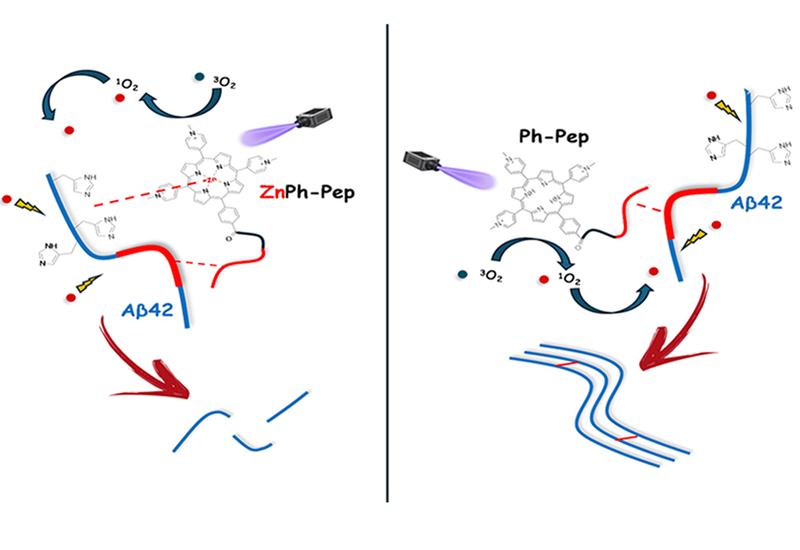
Alzheimer's disease has no cure, and the amyloid cascade that drives it has proven resistant to intervention. A decrease in monomeric Aβ levels accompanied by an increase in Aβ oligomers ranks among the disease's major neuropathological biomarkers, making strategies that degrade or remodel Aβ assemblies an active area of inquiry. Porphyrins and porphyrin–peptide bioconjugates generate the highly oxidant singlet oxygen, ¹O₂, upon light excitation, and prior work established that they can affect Aβ. What those earlier studies did not elucidate, the authors note, were the degradation mechanisms, the reactive species generated upon porphyrin photoexcitation, and the key reactions responsible for Aβ oxidation. Without that mechanistic picture, rational design of photoactivatable anti-amyloid constructs could not advance.
Researchers in the Di Natale Group at the Institute of Crystallography, National Research Council, Catania, and the Sortino Group at the University of Catania, published in Bioconjugate Chemistry, designed ZnPh-Pep to close that gap. The conjugate pairs a zinc-metallated porphyrin with a KLVFF recognition sequence, exploiting two binding modes: the KLVFF motif targets the amyloid core, while the zinc ion coordinates the imidazole groups of histidine residues in the N-terminal domain of Aβ, an interaction identified in prior work. This dual recognition yields an approximately order-of-magnitude affinity gain relative to previously described analogues. The authors propose that proximity to those histidine residues could modulate singlet oxygen-driven oxidation, promoting processes that lead to protein degradation. Working with monomerized Aβ42 to exclude oligomeric forms at this early stage, the team used mass spectrometry to track photooxidation products: ¹O₂ photogenerated by ZnPh-Pep induces extensive oxidation of Aβ42, yielding peroxidic and hydroperoxidic species, and provides evidence of partial Aβ42 degradation.
Full photophysical data, mass spectrometric assignments, and the authors' mechanistic framework are available in the original publication.