Locking the Helix

Reflecting work in the Wendeborn and Shahgaldian Groups

Published here August 24, 2026

Induction and Stabilization of Peptide Alpha-Helices on Silica Nanoparticles

Fidel Lozano-Elena, Seyed Amirabbas Nazemi, Patrick Shahgaldian, Sebastian Wendeborn

Angew. Chem. Int. Ed. 2026, e8942173. https://doi.org/10.1002/anie.8942173

View Original Publication


Short peptides are notoriously poor at maintaining α-helical structure in solution at physiological temperatures: the same flexibility that allows folding also allows unfolding. Prior work showed that adsorption onto gold, silica, or hydroxyapatite nanoparticles can coax peptides into helical conformations, but those interactions are ionic, and the resulting structures tend to be sensitive to changes in temperature, pH, and salt concentration. For applications where a peptide must present a defined structural face to a partner protein, that fragility is a genuine obstacle: the helix must stay helical even under stress, and the binding face must remain solvent-exposed and accessible.

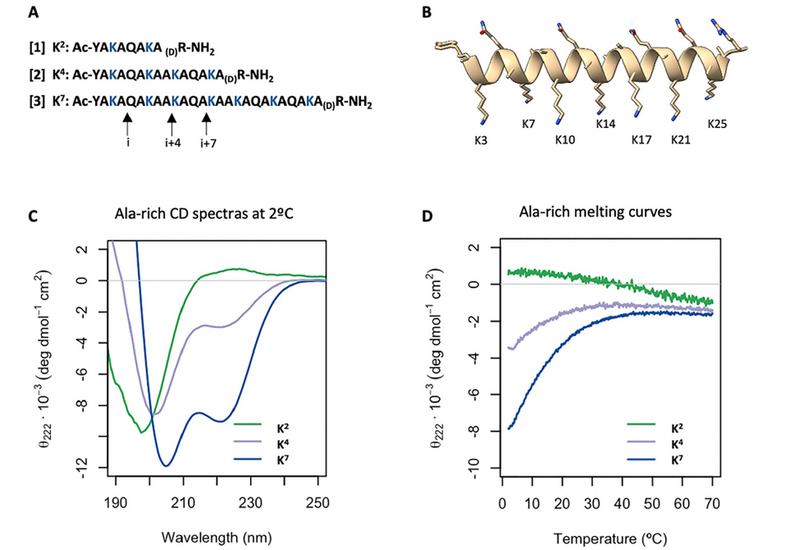
Researchers in the Wendeborn and Shahgaldian Group at the University of Applied Sciences and Arts Northwestern Switzerland, published in Angewandte Chemie International Edition, addressed this by turning the chemistry of surface immobilization itself into a conformational selection tool. Their approach begins with alanine-rich peptides carrying lysine residues positioned to fall on a single face of a prospective α-helix. At alkaline pH and low temperature, the peptide pre-folds in solution, aligning those lysine side chains. The peptides then encounter glutaraldehyde-activated, amine-functionalized silica nanoparticles, SNPs, under conditions where reversible imine bonds can form and exchange, sampling surface-attachment geometries until the helical conformation is thermodynamically favored. Reductive amination with NaBH4 then converts those dynamic imines into stable secondary amines, locking the peptide covalently to the SNP surface in its helical pose. A systematic study of lysine spacing reveals a key design trade-off: placing one lysine per helical turn maximizes thermal stability, while spacing attachments every two turns yields a more geometrically ideal helix at lower temperatures but with reduced stability at high temperatures. Critically, the face of the helix oriented away from the nanoparticle surface remains accessible, as confirmed by streptavidin-binding experiments in which immobilized peptides capture their protein partner and retain that capacity, to a measurable degree, even after incubation at 70°C.

The result is a sequence-guided framework for building thermally robust peptide helices on nanoparticle surfaces without sacrificing the functional interface. The approach is compatible with different dialdehyde linkers and, in principle, extensible to any bioactive helix whose attachment residues can be positioned on one face. The full binding data, structural characterization, and design rules for lysine patterning are detailed in the original publication.



Author

Seyed Amirabbas Nazemi, Ph.D., earned his B.Sc. in Chemical Engineering from Arak University, Iran, followed by an M.Sc. in Nanobioscience from Université Grenoble Alpes, France. He later earned his Ph.D. in Biochemistry from the University of Basel, Switzerland, conducting his research at the University of Applied Sciences and Arts Northwestern Switzerland, FHNW, under the supervision of Professor Patrick Shahgaldian. His doctoral and postdoctoral research has focused on protein stabilization, nanobiocatalysis, bioconjugation, and the engineering of biomolecules at functionalized surfaces for applications in biocatalysis and biosensing. His research interests center on understanding how surface modification, functionalization, and tailored microenvironments influence biomolecular structure and function. He is currently a postdoctoral researcher at FHNW, where he continues to work at the interface of biochemistry, nanotechnology, and biomolecular engineering.

Author

Patrick Shahgaldian, Ph.D., obtained his Ph.D. under the supervision of Dr. Anthony W. Coleman at the CNRS Institute of Biology and Chemistry of Proteins in Lyon, France, followed by a postdoctoral fellowship at the University of Basel, Switzerland. He subsequently joined the University of Applied Sciences and Arts Northwestern Switzerland, FHNW, where he is Professor of Molecular Nanotechnology and leads the Laboratory of Molecular Nanotechnology. He is also a Senior Member of the Swiss Nanoscience Institute. His research focuses on molecular self-assembly and the bottom-up design of functional nanosystems, with particular emphasis on exploiting biomolecules, including proteins, as functional elements for molecular recognition and biocatalysis. He is also co-founder of the companies INOFEA and Perseo Pharma.

Author

Sebastian Wendeborn, Ph.D., is Professor and Head of the Institute for Chemistry and Bioanalytics at the School of Life Sciences, University of Applied Sciences and Arts Northwestern Switzerland, FHNW. He has extensive experience in academic and industrial R&D, with a career spanning topics in organic chemistry, crop protection, fungicide and herbicide research, crop enhancement, computational chemistry, process research, and laboratory automation. Before joining FHNW in 2019, he held several scientific and managerial positions in the R&D organizations of Syngenta, Novartis, and Ciba-Geigy.

He studied Chemistry at the University of Freiburg in Germany, the University of Pennsylvania, and the University of California, San Diego, where he obtained his Ph.D. with K. C. Nicolaou. He subsequently conducted postdoctoral research at ETH Zürich with Prof. A. Eschenmoser. He is co-author of more than 120 scientific publications and patents.

His current research interests include organic and bioorganic chemistry, plant signaling, molecular glues, peptide and protein chemistry and structure, design and use of bioactive peptides, selective chemical modification and cleavage of proteins, as well as advancing the use of photochemical methods.

Locking the Helix

FIGURE 1 | Alanine-rich peptidesform α-helices insolution at lowtemperature. A |Sequence of the Ala-rich peptides. One lysine is introduced in every turn of the α-helix,at the position i, i+4, i+7, i+11, i+14, et cetewra. B | Model of the longest Ala-rich peptide, K7 [3], designed to expose all lysine sidechains to the same side of an α-helix. C | CD spectrum of K7peptide,[3], in solution. D |Ellipticity at 222 nm of the three Ala-rich peptides in function of increasing temperature.


Author

Fidel Lozano-Elena, Ph.D., is currently a Senior Researcher establishing an independent line and group at Institute of Bioengineering of Catalonia, IBEC, in Barcelona. His focused on computational design of peptides and proteins to promote non-cognate protein-protein interactions and develop conditional protein switches with therapeutical applications. Biotechnologist by training, he developed expertise in molecular biology and bioinformatics during his Ph.D studies, which focused on plant steroid signaling under abiotic stress in the laboratory of Prof. Caño-Delgado. Following three years focused on tech transfer activities, he joined Prof. Wendeborn’s lab at FHNW in Basel, where he studied, designed and synthetized plant peptides acting as molecular glues and investigated strategies to stabilize peptide secondary structures. He is author of 10 peer-reviewed articles and co-inventor of two patents.