Loop Surprise

Reflecting work in the Faure & Taillefumier Lab

Published here September 29, 2026

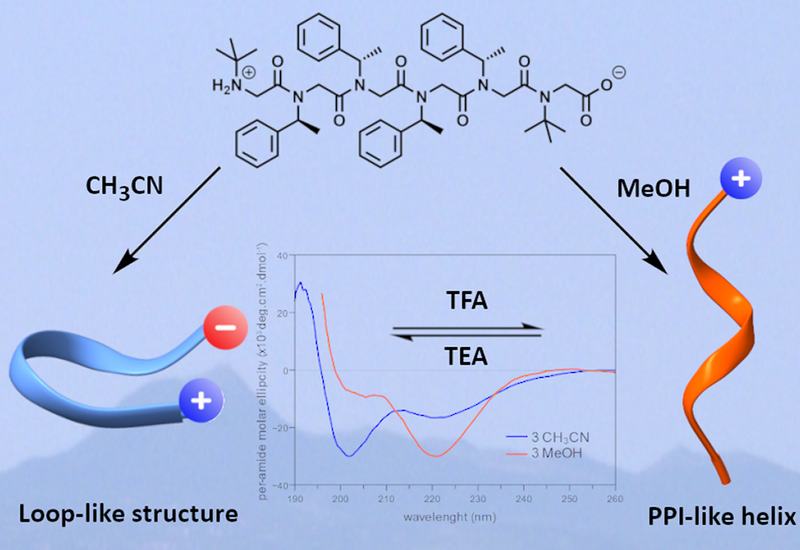
A Looplike Secondary Structure Uncovered in a Family of Peptoid Hexamers

Zacharie Bordas, Baptiste Legrand, Souleymane Sarr, Anne-Sophie Biesse-Martin, Emmanuel Wenger, Claude Didierjean, Olivier Roy, Sophie Faure, and Claude Taillefumier

J. Am. Chem. Soc. 2026, 148, 33251–33262. https://doi.org/10.1021/jacs.6c06943

View Original Publication


Peptoids, N-substituted glycine oligomers, have earned their reputation as programmable foldamers through a growing catalogue of secondary structures: polyproline-type helices, ribbons, square helices, and, in nonamers, a threaded loop. The amide bonds in peptoid chains equilibrate between cis and trans geometries, and the prevailing wisdom holds that side chains promoting cis amides drive oligomers toward helical conformations. When researchers set out to probe how chiral aromatic side chains cooperate with bulky tert-butyl termini to reinforce helical order, they expected another variant of that familiar story. The hexamer H-NtBu-(Nspe)4-NtBu-OH produced instead a ¹H NMR spectrum of exceptional clarity in both acetonitrile and chloroform, a hallmark not of a helix beset by conformational exchange but of a single, well-defined architecture that nobody had anticipated.

Researchers in the Faure and Taillefumier Groups at Université Clermont Auvergne, published in the Journal of the American Chemical Society, traced the origin of this fold to a cis–cis–trans–cis–cis arrangement of the five backbone amide bonds, a pattern previously documented only in cyclic hexapeptoids. The single central trans junction allows the chain to reverse direction so that the free N-terminal ammonium and C-terminal carboxylate come within bonding distance, forming a 19-membered pseudoring secured by a head-to-tail salt bridge rather than by covalent cyclization. NMR-derived distance restraints combined with simulated annealing converged on a compact structure whose backbone overlays with that of a crystallographically characterized cyclic hexapeptoid to within 0.238 Å across 11 backbone atoms. Critically, the loop depends on the zwitterionic state: acetylating the N-terminus abolishes the fold and restores a conventional helix, while replacing the four central aromatic Nspe units with aliphatic monomers leaves the cctcc amide arrangement intact, confirming that the terminal salt bridge, not aromatic stacking, governs folding.

Because protonation state controls the fold, the loop and helix interconvert cleanly on addition of acid or base, a switching cycle repeated four successive times without measurable loss of fidelity. This acid–base conformational switch between two fully defined peptoid secondary structures in a linear chain is the first of its kind, and it expands the design palette for peptoid foldamers toward switchable architectures with potential uses in stimuli-responsive encapsulation, asymmetric catalysis, and molecular sensing. The full structural data and switching characterization await in the original publication.


Author

Dr. Baptiste Legrand received his Ph.D. in Life Sciences and Health, structural biology, from the University of Rennes in 2009, and then spent two years as a postdoctoral fellow at the Laboratory of Macromolecular Chemistry and Physics, LCPM, Nancy, where he characterized foldamer structures by combining NMR, CD and FTIR spectroscopies with molecular dynamics simulations. He joined the IBMM in 2012. His research is devoted to rationally designed architectures for applications in health with a focus on three-dimensional structure determination, on the mechanisms governing the folding and stability of complex edifices at the atomic scale, and on peptide self-assemblies. Current applications include the development of antimicrobials and of protein–protein interaction inhibitors. Since September 2023, Baptiste has been an elected member of the board of the “Groupe Français des Peptides et Protéines,” GFPP, The French Peptide Society.

Author

Dr. Olivier Roy is Associate Professor of organic chemistry at the Institute of Chemistry of Clermont-Ferrand, ICCF, at the University of Clermont Auvergne. He earned his Ph.D. in organic chemistry in 2001 from the University of Reims Champagne-Ardennes, followed by postdoctoral research with Prof. G. Pattenden at the University of Nottingham, then at the university of Lyon I with Dr. B. Langlois. In 2004, he moved to Clermont-Ferrand as temporary Lecturer and joined the group of Prof. D. J. Aitken. In 2006, he was appointed as a Lecturer in the Peptoid Group at ICCF. His current research focuses on the synthesis of peptoids and the investigation of their conformational properties.

Author

Dr. Sophie Faure is CNRS Research Director at the Institute of Chemistry of Clermont-Ferrand at Université Clermont Auvergne. She received a Ph.D. in organic photochemistry in 1999. Following postdoctoral work in Enders’ group in Germany and at the faculty of Pharmacy Paris-Descartes, she joined the National Centre for Scientific Research, CNRS, in 2002, she focused on the total synthesis of marine macrocyclic peptides with Prof. Aitken. Then, she turned her interest towards the synthesis and the foldameric properties of peptidomimetic oligomers. In 2021, she was appointed Research Director, with her primary research focus on designing peptoid and arylopeptoid oligomers that mimic the structure and activity of native peptides or protein segments for therapeutic applications. In 2022-23, she served as President for the French Peptide Society, Groupe Français des Peptides et Protéines, GFPP.

Author

Claude Taillefumier, Ph.D., is Professor of Organic chemistry at the University of Clermont Auvergne in France. He is currently affiliated with the Institute of Chemistry of Clermont-Ferrand, ICCF. He studied chemistry at the University of Nancy in France, earning his Ph.D under the supervision of Dr Yves Chapleur. His research focused on the synthesis of HMG-CoA reductase inhibitors. For about ten years, he was employed as an associate professor in the field of sugar chemistry with a particular focus on exo-glycals, their conversions into sugar amino acids and their subsequent oligomerization. This work sparked his interest in foldamers, leading him to join Professor G. W. J Fleet’s group at the Dyson Perrins Laboratory in Oxford as a visiting researcher in 2000. He was appointed Professor at Blaise Pascal University in Clermont-Ferrand in 2005 and has since continued to conduct research in the field of foldamers, with a particular focus on biotic peptoid oligomers. His research focuses on α-peptoids and other related backbones, their folding and conjugation, as well as their applications in medicinal chemistry, particularly as modulators of protein-protein interactions. This article, published in JACS in 2026, provides a perfect illustration of his fundamental research into peptoid chain folding.

Loop Surprise

Author

Zacharie Bordas, Ph.D., earned his doctorate in organic chemistry in December 2025 from the Institut de Chimie de Clermont-Ferrand, ICCF, Université Clermont Auvergne, within the Chimie Organique et Médicinale team, under the supervision of Dr. Olivier Roy, Prof. Claude Taillefumier, and Dr. Sophie Faure. His doctoral research focused on the solid-phase synthesis of sterically constrained peptoids and the structural elucidation, by NMR, circular dichroism and X-ray diffraction, of a new looplike secondary structure in peptoid hexamers. This research was conducted in collaboration with laboratories in Montpellier, IBMM, and Nancy, CRM2. His research interests extend to foldamer and peptidomimetic chemistry more broadly, including PNAs and oligoureas. He is co-author of two publications from his thesis work and is currently seeking for a postdoctoral position in the field.