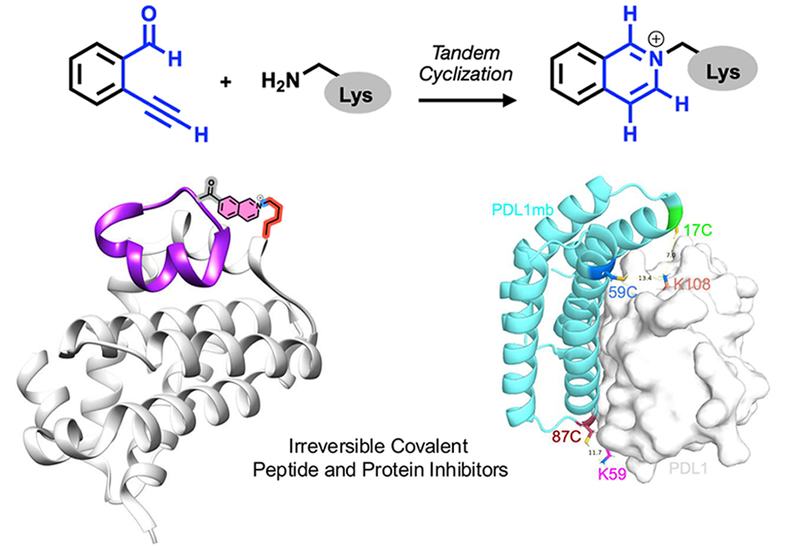
Covalent inhibitors have become a mainstream modality in drug discovery, but the field has a target problem. Cysteine is the preferred nucleophile for electrophilic warheads, yet it accounts for only roughly 1.9% of residues across the proteome and appears infrequently at protein-protein interfaces, the sites most relevant to peptide therapeutics. Lysine is far more surface-exposed and interface-relevant, but existing lysine-reactive chemistries carry liabilities: most generate heterogeneous products, are reversible, or have not been adapted beyond small molecules. Sulfonyl fluoride electrophiles, the leading alternative, face concerns about hydrolysis susceptibility and low intrinsic reactivity without a neighboring arginine residue. The field has lacked a lysine-selective, irreversible warhead that is chemically compatible with solid-phase peptide synthesis and biocompatible aqueous conditions, and that can be placed predictably relative to a target nucleophile.
Researchers in the Baker Group at the University of Washington, published in ACS Chemical Biology, generalize 2-ethynylbenzaldehyde, EBA, as a proximity-induced electrophile that reacts selectively and irreversibly with primary amines via isoquinolinium formation at physiological pH. To place EBA at productive positions on structured binders, the team built a computational "reactivity sphere" tool that screens a target–binder complex for sites where the Cβ–Cβ distance to a target lysine falls below 11.5 Å and the Cα–Cβ vectors converge. Applying this workflow to MCL1, an EBA-armed cyclic peptide achieved a 61-fold increase in potency relative to the parent non-covalent peptide and a 22-fold increase relative to a sulfonyl fluoride warhead, with site selectivity confirmed by blocking K234 prior to treatment.
Demonstrations on two protein targets, including cellular labeling of PD-L1 in live A375 human melanoma cells, point toward applicability across de novo designed binders where cysteine is absent. The full kinetic and selectivity data, substrate scope, and mechanistic controls are in the original publication.