Macrocyclic peptides containing aromatic and heteroaromatic backbone linkages occupy an attractive region of chemical space for drug discovery, combining resistance to proteolysis with the potential for "chameleonic" conformational switching that can facilitate membrane permeability. Rational optimization of these scaffolds demands accurate knowledge of their solution-state conformational ensembles, and this is precisely where conventional methods fall short. Nuclear Overhauser effects, NOEs, report on time-averaged interproton distances and can collapse a genuinely dynamic system into a single artificial intermediate structure that satisfies the averaged constraints while failing to represent any thermodynamically populated conformer. Classical molecular dynamics force fields compound the problem by performing poorly on noncanonical heterocycles. The result is structural models that look converged but are systematically misleading, making it difficult to rationalize activity cliffs or guide synthetic modification toward desired pharmacological properties.
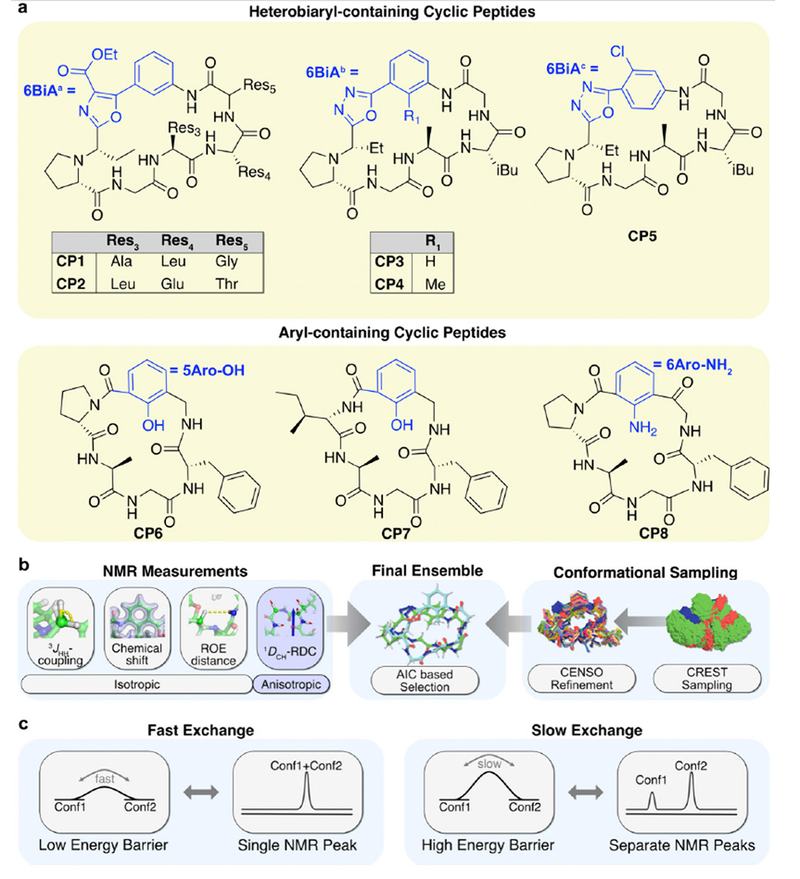
Researchers in the Sun Group at the Leibniz-Forschungsinstitut für Molekulare Pharmakologie and the Yudin Group at the University of Toronto, published in J. Am. Chem. Soc., addressed this limitation by building an integrative framework that combines complementary isotropic and anisotropic NMR observables with density functional theory, DFT, based conformational sampling. The key advance is the inclusion of residual dipolar couplings, RDCs, alongside scalar couplings, 13C chemical shifts, and rotating-frame Overhauser effect distances. Unlike NOEs, RDCs provide long-range orientational restraints independent of interatomic distance, encoding global molecular shape and subunit orientation rather than local averaged geometry. Candidate conformers are generated via the CREST enhanced-sampling tool, refined at the DFT level with CENSO, and then selected by simultaneous fitting of all observables using the Akaike information criterion within Stereofitter. Applying this workflow to eight aryl- and heterobiaryl-linked cyclic peptides, the team finds that every macrocycle in the set requires an ensemble of up to three interconverting backbone conformers to reconcile the experimental data, a result that prior single-structure NOE analyses had not captured. Notably, aromatic linkages substantially lower the cis/trans proline isomerization barrier relative to canonical peptides, producing fast conformational exchange invisible to standard signal-counting diagnostics.
The framework identifies backbone linkage identity as the primary determinant of global macrocycle shape, with hydrogen-bonding networks representing a secondary layer of dynamics. This hierarchy has direct implications for medicinal chemistry: single-atom substitutions that appear peripheral can selectively repopulate minor conformers with distinct hydrogen-bonding patterns, rationalizing otherwise unpredictable activity cliffs. Validated in both DMSO and methanol, and with full structural ensembles deposited openly on Zenodo, the approach is immediately transferable to next-generation peptide therapeutic candidates.