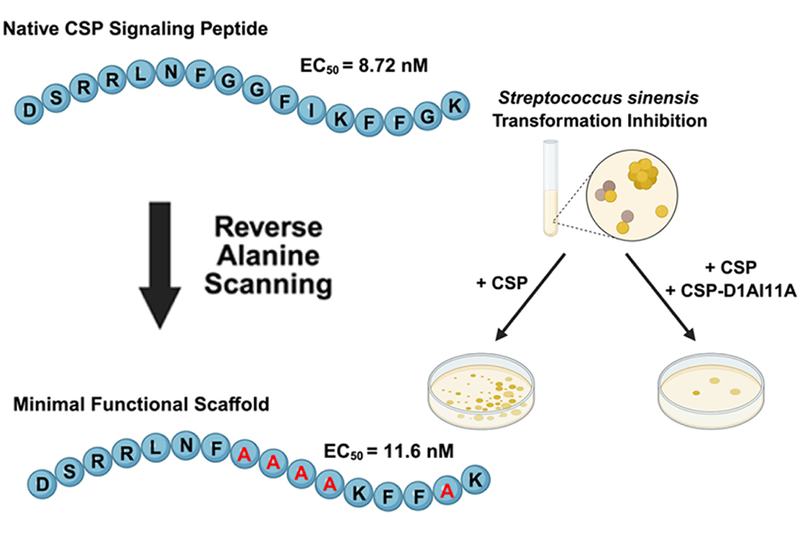
Quorum sensing, QS, in Streptococcus sinensis is mediated by a competence-stimulating peptide, CSP, that activates the ComD receptor to coordinate natural competence and other population-level behaviors. Prior work established that the S. sinensis CSP tolerates single-amino acid substitutions to an unusual degree, yet the minimum structural features required for productive receptor activation remained unknown. Without that map, rational design of simplified agonists or antagonists had no firm foundation. The system posed a particular puzzle: if the receptor accepts such a broad sequence space, does any constrained set of features actually govern activation, or is the signal simply noise-tolerant across the board?
Researchers in the Tal-Gan Group at the University of Nevada, Reno, published in ACS Chemical Biology, addressed this question through reverse alanine scanning, a strategy that begins with an all-alanine scaffold and systematically restores native residues to identify those truly essential for activity. Iterative restoration identified multiple minimal functional scaffolds of S. sinensis CSP that retained native levels of quorum sensing activation despite replacement of nearly one-third of the peptide sequence with alanine. Reintroduction of positions F10 and I11 rendered those variants insoluble, so both were excluded from further restoration. A single D1A substitution converts minimal agonist scaffolds into competitive antagonists while preserving relative potency trends, a correlation the authors note is relatively unique to S. sinensis and should not be extrapolated to other streptococci.
The work delineates the minimal structural features required for S. sinensis QS activation and establishes a foundation for rational design of peptide-based QS modulators. The authors note that further modification of these minimal functional scaffolds, along with incorporation of the D1A mutation, could potentially yield even more potent S. sinensis QS modulators. The full structure-activity data, inter-species crosstalk results, and competence suppression assays are available in the original publication.