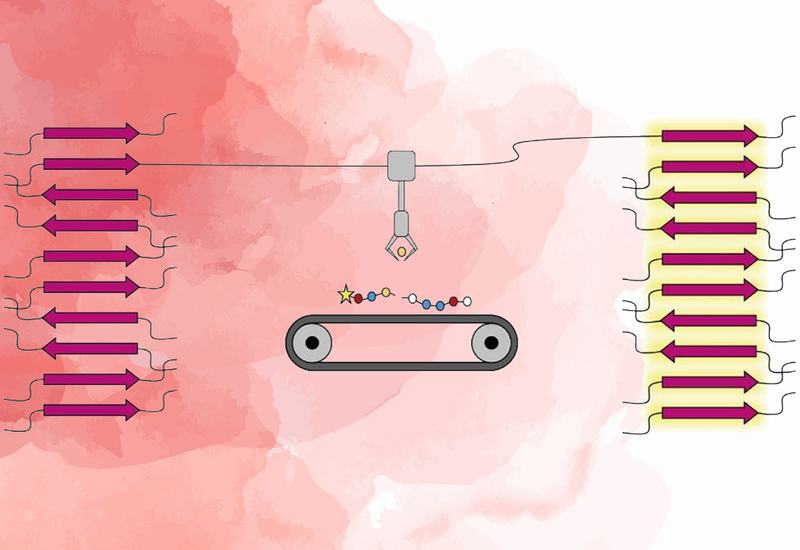
Amyloid fibrils are a defining feature of neurodegenerative diseases including Alzheimer's, Parkinson's, and Huntington's disease, yet molecular tools capable of both recognizing and manipulating these assemblies remain scarce. Peptides are an attractive platform because their sequences can exploit the π–π stacking, cation–π interactions, and backbone hydrogen bonding that characterize amyloid β-sheet surfaces. The obstacle has been a lack of scaffolds that permit systematic dissection of how sequence composition, charge, and stereochemistry govern fibril recognition while leaving enough chemical room to attach diagnostic or therapeutic payloads. Without that modularity, each new application demands a new design effort from scratch.
Researchers in the Rüdiger Group at Utrecht University and the Friedler Group at the Hebrew University of Jerusalem, published in Chemistry – A European Journal, built on an earlier peptide, FibrilPaint1 (FP1), a 22-residue fluorescein-labeled binder with nanomolar affinity for multiple amyloid species, to define the molecular rules of recognition. FP1 contains three elements: an aromatic- and arginine-rich core with the degenerate composition W5P4H3R2, a flexible GSGS linker, and a C-terminal EEVD motif that recruits the E3 ligase CHIP. The team synthesized twelve derivatives that independently varied overall charge, sequence order, linker presence, and backbone chirality, then measured binding to preformed TauRD and HttEx1Q44 fibrils by flow-induced dispersion analysis, FIDA, a microfluidics method that reports peptide–fibril association as a size increase in hydrodynamic radius. Scrambling the residue order while preserving composition still produced binding, pointing to distributed surface contacts rather than a single ordered epitope. Replacing L-amino acids with D-amino acids abolished binding entirely, revealing a strict stereochemical complementarity between the peptide backbone and the fixed geometry of the fibril surface. Sequences outside the core binding unit could be deleted or charge-inverted without consequence, confirming that the amyloid-targeting unit and any effector module can be optimized independently.
Because the active FibrilPaints engage both Tau and Huntingtin fibrils, which share only the cross-β architecture, the recognition appears to target a conserved amyloid surface feature rather than a protein-specific epitope. That breadth, combined with demonstrated tolerance for diverse C-terminal payloads, positions FibrilPaints as a tunable scaffold for attaching fluorophores, E3-recruiting motifs, or autophagy-targeting tags, and opens a path toward bifunctional molecules that can both label and drive clearance of disease-associated amyloid assemblies.