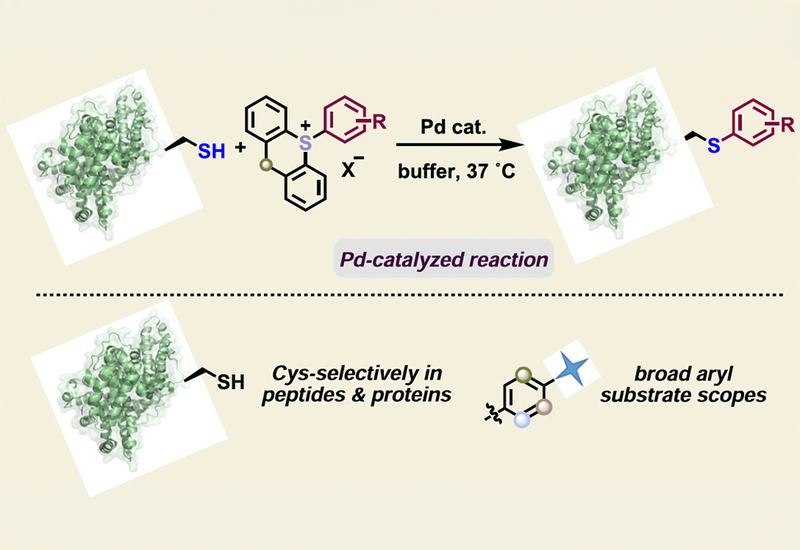
Cysteine bioconjugation underpins a wide swath of peptide-drug conjugates, chemical probes, and targeted diagnostics, yet each established method carries a fundamental liability. Maleimide adducts are susceptible to retro-Michael pathways in circulation, causing premature payload loss and off-target toxicity. Electrophilic SNAr reagents suffer narrow substrate scopes and cross-reactivity with other nucleophilic residues. Stoichiometric organometallic protocols require multistep preparation of air- or moisture-sensitive complexes. Photoredox and electrochemical systems typically demand rigorous deoxygenation or sustained high-energy irradiation that risks photo-oxidative damage to native residues such as Trp, Tyr, and Met. The field therefore lacks a cysteine arylation platform that is simultaneously stable, selective, operationally straightforward, and compatible with intact biomolecules.
Researchers in the Xu Lab at Lanzhou University, published in JACS Au, reason that aryl thioethers offer superior chemical and enzymatic stability relative to maleimide linkages, and that aryl thianthrenium salts could unlock that linkage under mild conditions because their rapid oxidative addition to Pd(0) bypasses the sluggish kinetics that force conventional aryl halide protocols to demand elevated temperatures of 50 to 65 °C or high catalyst loadings in water. Screening converges on RuPhos-Pd-G3 in 1.0 M Tris-HCl buffer at pH 8.5 and 37 °C, delivering site-selective cysteine arylation without added base, photoinitiator, or organic cosolvent. The authors frame the work as a methodological proof of concept for assembling structurally complex peptide-drug conjugates, and further evaluation is needed to establish the suitability of the conjugates for in vivo applications.
The aryl thioether linkage formed here is chemically and enzymatically stable in ways that maleimide adducts are not, and the operational profile, aqueous buffer, body temperature, no photochemistry, positions this chemistry to reach peptides and proteins that prior catalytic arylation platforms could not. The authors anticipate that the operational simplicity and stable aryl thioether output will make this approach a valuable addition to the bioconjugation toolbox, accelerating the discovery of chemical probes, targeted diagnostics, and next-generation peptide- and protein-based therapeutics.