Pocket Engineering Polymyxin

Reflecting work in the Kries Lab

Published here October 15, 2026

Adenylation Domain Engineering Enables Biosynthesis of an Improved Polymyxin Antibiotic

Maximilian Müll, Pia Lanvers, Giulia Ravagnan, Kilian Klaus, Olena Nosovska, Ivan Vilotijevic, Jochen Schmid, Hajo Kries

Angewandte Chemie International Edition 2026, e9880949. https://doi.org/10.1002/anie.9880949

View Original Publication


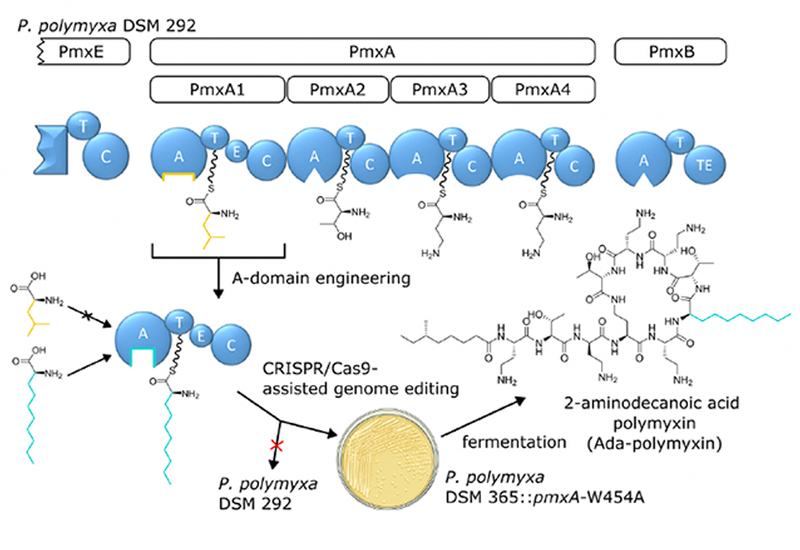
Polymyxins remain a last-resort defence against Gram-negative bacterial infections, yet their clinical utility is constrained by acute nephrotoxicity and spreading resistance fuelled by agricultural overuse. Analogues carrying L-2-aminodecanoic acid, L-Ada, in place of the fatty amino acid side chain have shown activity against resistant clinical isolates of Acinetobacter baumannii and good tolerability in mouse thigh models, but until now they have only been accessible through total synthesis. Biosynthetic production from the native nonribosomal peptide synthetase, NRPS, machinery of Paenibacillus polymyxa was blocked because the adenylation domain of PmxA1 selects for L-leucine: the bulky L-Ada side chain sterically clashes with the wild-type binding pocket and cannot be adenylated.

Researchers in the Kries Lab at the University of Stuttgart, published in Angewandte Chemie International Edition, reasoned that the obstacle was geometric: a homology model built with the Chai-1 pipeline showed that Trp454 caps the base of the substrate-binding pocket, forcing the L-Ada side chain into a distorted conformation that, as the authors note, only suggests rather than proves an explanation for the lack of adenylation activity. Precedent in homologous A-domains indicated that replacing the bulky tryptophan with alanine could open the pocket to larger substrates. Integrating W454A into P. polymyxa DSM 365 and supplementing cultures with exogenous L-Ada enabled direct fermentative production of Ada-polymyxin at 6.3 ± 0.3 μM, quantified assuming identical LC-MS/MS responses for Ada-polymyxin and a polymyxin B1 standard, though the engineered strain displayed cell lysis and declining viable counts after 50 h, indicating self-intoxication at that concentration.

The authors describe this result as a solid foundation for further strain improvement, and they identify endogenous L-Ada biosynthesis, enhanced producer resistance to self-intoxication, and optimisation of downstream domains as the next engineering priorities. More broadly, the work indicates a strategy of replacing bulky pocket residues to admit larger noncanonical building blocks, an approach that, the authors suggest, may extend to other NRPS systems. The full kinetic characterisation, strain engineering details, and antimicrobial data are available in the original publication.


Author

Prof. Dr.-Ing. Jochen Schmid is Full Professor of Microbiology at the University of Münster, Germany. He earned his diploma in biotechnology from the Technical University of Berlin, where he completed his Ph.D. on polysaccharide biosynthesis in basidiomycetes. As a postdoc and group leader at the Technical University of Munich in the lab of Prof. Dr. Volker Sieber, he established the first CRISPR-Cas system for Paenibacillus polymyxa. Following an associate professorship at the Norwegian University of Science and Technology, NTNU, in Trondheim, he returned to Germany to join the faculty at Münster. His research integrates molecular microbiology, synthetic biology, metabolic engineering, and bioprocess development to create innovative bio-based materials and industrial biotechnology solutions.

Author

Prof. Dr. Hajo Kries is Full Professor of Technical Biochemistry at the University of Stuttgart, Germany. He earned his M.Sc. in Chemistry and Ph.D. in Biochemistry from ETH Zurich, where his doctoral research focused on enzyme design and directed evolution. After postdoctoral research at the John Innes Centre in Norwich, UK, with Prof. Dr. Sarah E. O’Connor, he led an independent junior research group at the Leibniz Institute for Natural Product Research and Infection Biology in Jena, Germany. His research focuses on enzyme engineering, biocatalysis, and engineering nonribosomal peptide biosynthesis to access and improve bioactive peptides.

Pocket Engineering Polymyxin

Author

Maximilian Müll earned his B.Sc degree at the University of Applied Sciences Offenburg, Germany, in process engineering and his M.Sc in Biotechnology in a double degree program between the University of Applied Sciences Offenburg and the University of Warmia and Mazury in Olsztyn, Poland. Maximilian is currently a Ph.D. candidate at the University of Stuttgart, Germany, in Technical Biochemistry under the supervision of Prof. Dr. Hajo Kries. During his Ph.D. he stayed 4 years at the Leibniz Institute for Natural Product Research and Infection Biology Hans Knöll Institute in Jena, Germany. His Ph.D. focuses on making novel building blocks accessible for nonribosomal peptide biosynthesis and their application in the biosynthesis of improved drugs. He recently submitted his dissertation.