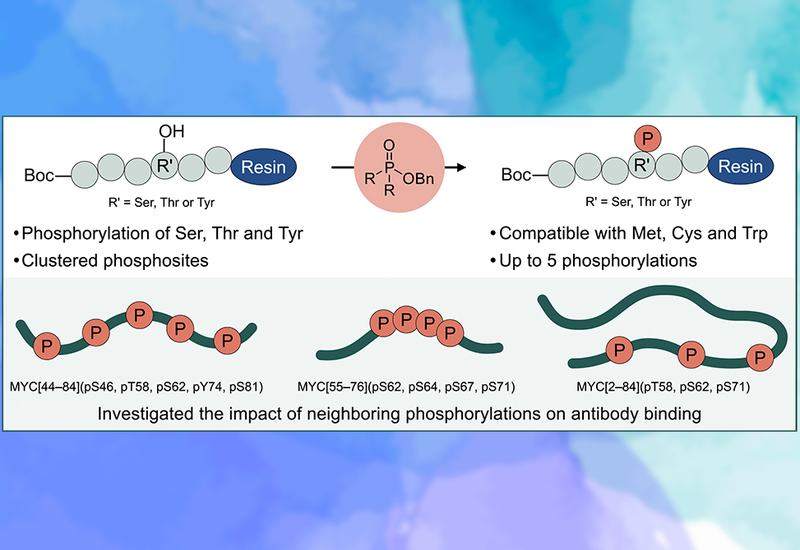
Protein phosphorylation rarely arrives alone. Transcription factors such as the intrinsically disordered protein MYC carry clusters of phosphoserine, phosphothreonine, and phosphotyrosine whose precise combinatorial patterns govern cellular decisions, yet accessing these site-selectively polyphosphorylated sequences has proved difficult. Global P(III)-based phosphorylation methods suffer from oxidation of methionine, cysteine, and tryptophan residues and can deliver conversions below 20% on sequences bearing multiple phosphosites. Pre-phosphorylated building blocks, meanwhile, are often difficult to couple and can lead to base-mediated elimination. The field has lacked a late-stage, on-resin strategy that tolerates oxidation-sensitive residues, scales to long sequences, and handles multiple phosphorylation events without extensive coupling protocols.
Researchers in the Hartrampf Group at the University of Zurich, published in the Journal of the American Chemical Society, addressed the problem by employing a benzyl-protected and activated phosphoramidate to site-specifically phosphorylate Ser, Thr, and Tyr in an on-resin, late-stage manner, achieving at least 95% conversion and tolerating oxidation-sensitive Met, Cys, and Trp residues. The P(V) species could only be decreased to 50 equivalents for monophosphorylation, as less gave insufficient volume to fully swell the resin; where more phosphosites are installed, the loading per site scales down considerably, to 10 equivalents per site across five sites. A key mechanistic requirement is that 1,2,4-triazole must be substoichiometric relative to the P(V) species; excess triazole likely generates a less reactive triazole-phosphate rather than the productive bridged diphosphate intermediate. Selectivity is achieved by incorporating side-chain-unprotected residues during SPPS, though for one residue the impact of unprotected side chains on crude purity is variable and requires more investigation.
The method scales to a pentaphosphorylated 41-residue MYC fragment, though purifying and characterizing these highly phosphorylated peptides presented a major challenge as they tended to exhibit pronounced tailing and broadening by HPLC. Applied to four commercially available phosphoMYC antibodies targeting pT58, pS62, pS71, and pS81, the precisely defined peptides revealed that cophosphorylation can diminish, deplete, or enhance antibody signals, and the MYC-pT58 antibody did not recognize shorter peptides beginning at residue 55, indicating that part of the epitope may be missing.