Nitrile groups enable covalent inhibition of cysteine and serine proteases, as seen in nirmatrelvir and vildagliptin, making peptide scaffolds that carry them well-established drug leads. Nature, however, appeared to leave ribosomally synthesized and post-translationally modified peptides, RiPPs, entirely out of this chemistry. Around 50 distinct RiPP classes have been catalogued, each defined by a class-specific post-translational modification, yet nitrile formation had never been documented among them. The one known nitrile-containing peptide natural product, auranthine, arises from nonribosomal biosynthesis, leaving open whether a genetically encoded precursor peptide could also acquire a C-terminal nitrile. Closing that gap would expand the structural diversity of RiPPs and expose new enzymatic logic for installing one of the most pharmaceutically relevant functional groups in peptide chemistry.
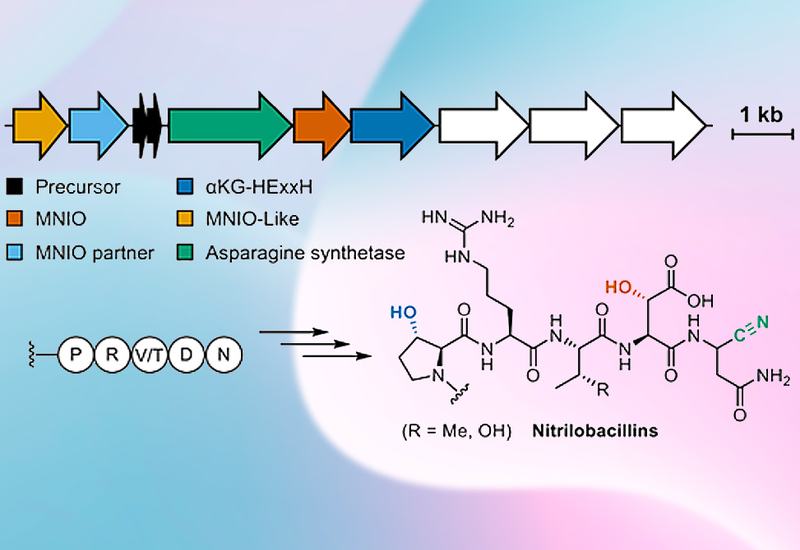
Researchers in the van der Donk Group at the University of Illinois at Urbana-Champaign, published in the Journal of the American Chemical Society, identified a biosynthetic gene cluster from Peribacillus simplex VanAntwerpen02 that encodes the full machinery for nitrile formation on a ribosomal peptide. Genome mining for clusters encoding multinuclear nonheme iron-dependent oxidative enzymes led to the cluster, designated pes. Heterologous expression, LC-HRMS, NMR, and IR spectroscopy established that three enzymes act in sequence on the precursor peptides PesA1 and PesA2, culminating in the asparagine synthetase-like enzyme PesC converting the C-terminal carboxylate to a nitrile. Mechanistic dissection of PesC showed that the reaction proceeds via ATP-dependent adenylation of the carboxylate, ammonia transfer from L-glutamine to yield an amide intermediate, and a second ATP-dependent adenylation that drives dehydration to the nitrile. A 13C NMR signal at 118.0 ppm and an IR triple-bond stretch at 2150 cm-1 confirmed the product.
By establishing nitrilation as a bona fide RiPP post-translational modification and naming the products nitrilobacillins, this work opens a new compound class for investigation. PesC tolerates shortened peptide substrates and accepts ammonia in place of L-glutamine, making it a promising biocatalytic handle for engineering C-terminal nitriles onto ribosomal scaffolds. The discovery of roughly 300 uncharacterized asparagine synthetase-like enzymes co-occurring with RiPP biosynthetic elements suggests the chemistry extends well beyond the current examples. Full mechanistic data, mutagenesis results, and structural models are available in the original publication.