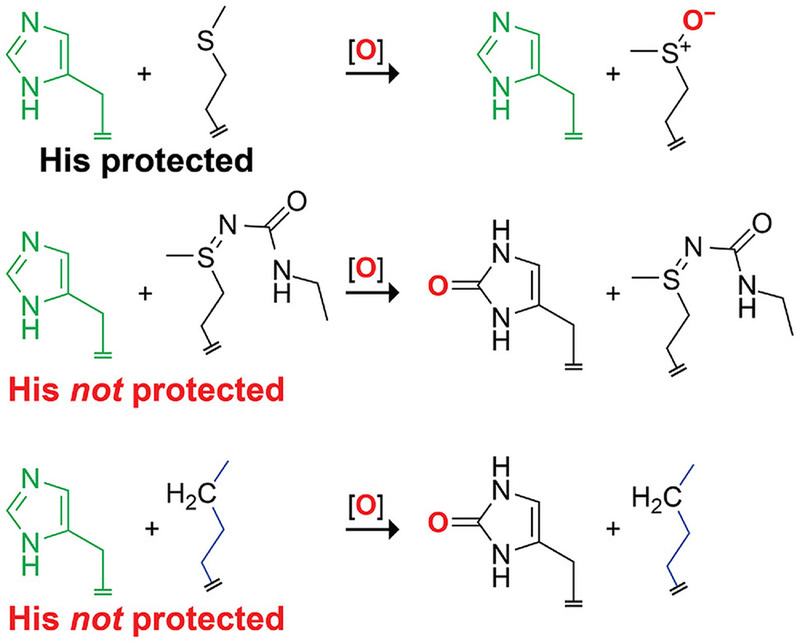
Histidine is the most common residue in enzyme active sites, and its electron-rich imidazole ring is also a ready target for reactive oxygen species. Electrophilic attack at C2 yields 2-oxohistidine, and no enzyme is known to reverse that change, so a single hit means the whole protein must be degraded and replaced. Methionine sits at the other end of that asymmetry, since its oxidation to the sulfoxide is undone by methionine sulfoxide reductases. Three decades ago, chemists proposed that methionine residues clustered near vulnerable sites might exploit the difference and absorb oxidants on a neighbor's behalf, forming a protective phalanx. The idea was attractive, but the reagents and the synthetic control needed to test it rigorously did not yet exist.
Researchers in the Raines Group at the Massachusetts Institute of Technology, published in Angewandte Chemie Novit, tested it in human ribonuclease 1, which carries five methionine residues, nearly double the proteomic average for its length, clustered around the catalytic pair His12 and His119. Conserved sulfur–arene contacts across 19 vertebrate homologs tune electron density at each methionyl sulfur, and the geometry pointed to Met29 and Met35 as the most oxidizable and therefore the most useful shields. The team removed those two from the antioxidative pool by orthogonal routes: capping the thioether with an oxaziridine probe, and building a variant carrying norleucine, a sulfur-free isostere of methionine, at positions 29 and 35. Both perturbations roughly halved the IC50 for oxidation-induced inactivation.
The synthesis carries its own weight here. Recombinant expression installs norleucine at every methionine, so site-selective substitution at two chosen positions meant building the 128-residue chain outright, which the authors did in a single automated fast-flow pass. Ribonuclease A was the first enzyme ever synthesized chemically, by Merrifield in 1969; the same target now takes hours rather than weeks. For peptide chemists the argument is that methionine placement is a design variable rather than an accident, and that oxidative resilience can be engineered residue by residue. Whether the same arrangement recurs in unrelated secretory proteins is taken up in the original publication.