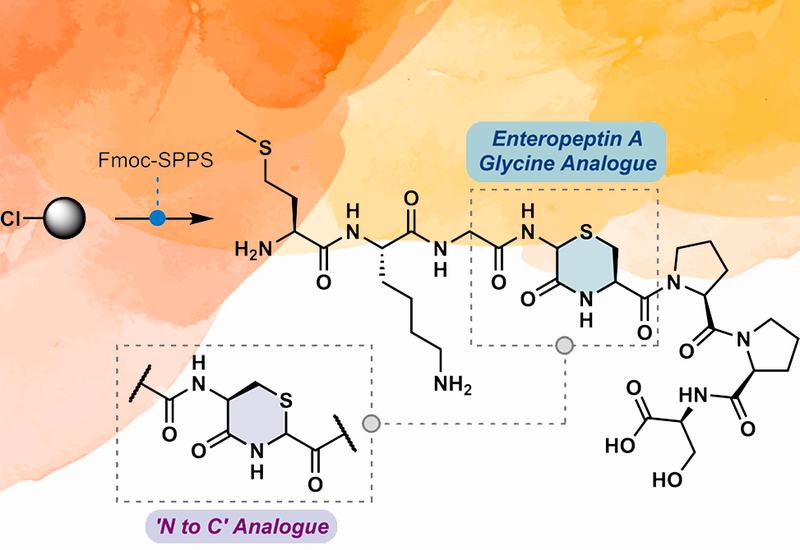
Enteropeptins A–C, sactipeptides isolated from the gut microbe Enterococcus cecorum, belong to a newly elucidated subclass defined by a six-membered thiomorpholine core rather than the macrocyclic thioether bridges typical of other sactipeptides. Enteropeptin A shows narrow-spectrum bioactivity against its producing strain, and analogue synthesis would open a path to probing how the core governs that activity. The first total synthesis relied on a solution-phase catalytic Markovnikov hydrothiolation to set the thiomorpholine ring. However, this step has not yet been extended to solid-phase peptide synthesis (SPPS), leaving an opportunity for the development of a practical solid-phase platform for analogue production.
Researchers in the Malins Group at Australian National University, publishing in Organic Letters, reported an SPPS-compatible approach to simplified enteropeptin A analogues bearing both “C to N” and “N to C” sactionine directionalities. For the “C to N” variant, a pre-formed, acyclic building block carrying the sactionine precursor could be cyclized directly on resin to afford a simplified thiomorpholine analogue. Cyclization involved activation of an α-hydroxyglycine residue with guanidinium chloride in TFA and subsequent attack by a pendant cysteine thiol to forge the C–S bond. The “N to C” glycine analogue was obtained from a pre-cyclized building block, which could be coupled directly on-resin. Analogues were afforded in 9% yield and 34% yield, respectively, for the “C to N” and “N to C” variants, over the 14 steps from resin loading. Stereochemical assignments and conformational insights into the individual diastereomers of each enteropeptin A analogue were supported by 2D NMR experiments, although additional studies, ideally aided by single-crystal X-ray analysis, will be necessary to fully ascertain these details.
Compatibility of both routes with standard Fmoc-SPPS provides a generalizable path to enteropeptin analogues. Bioactivity of the synthesized analogues has not yet been evaluated; future work will examine how the modified thiomorpholine core influences activity. Full synthetic details and comprehensive NMR studies are available in the original publication.