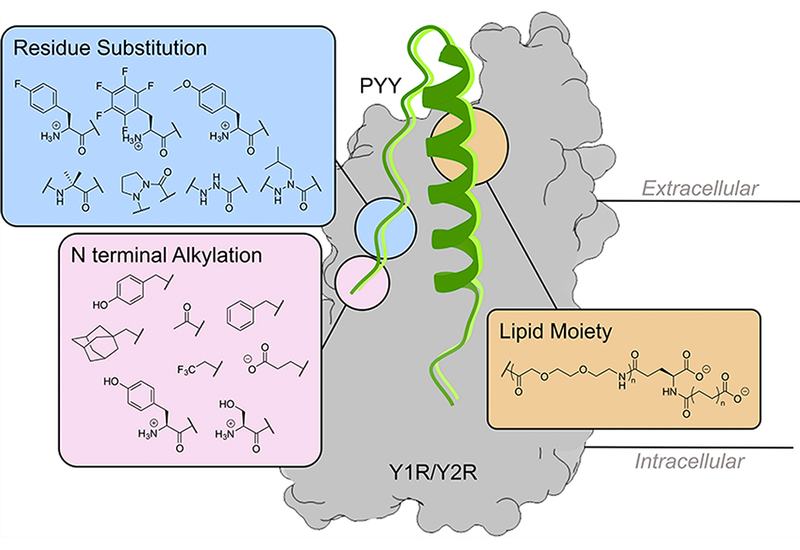
Peptide YY circulates as a full-length agonist of both Y1R and Y2R, but DPP4 removes its N-terminal dipeptide to yield PYY(3–36), a Y2R-selective fragment. The enzyme does not merely shorten the peptide’s life, it rewrites its receptor pharmacology. The two arms are not interchangeable: Y2R activation is associated with satiety, while Y1R carries pancreatic and glucoregulatory signaling, so truncation narrows what the intact hormone can do. Stabilizing the intact ligand presents an unusual conflict, because the Tyr1–Pro2 motif DPP4 recognizes is the same motif Y1R activation requires. The chemistries that protect GLP-1 and GIP from the enzyme all modify precisely that region, leaving the field’s standard solution unavailable.
Researchers in the Beinborn and Kumar Groups at Tufts University, published in Biochemistry, took another route, decorating the N-terminal amine rather than substituting the residues beneath it. The appended groups spanned a range of steric, electronic, and charge properties, testing how much chemical decoration the Y1R binding site would accept at a position long treated as untouchable. Alkylated analogues were no longer processed by DPP4, and control experiments established that they escape productive recognition rather than inhibiting the enzyme. The protection cost nothing at the receptor: an N-methyl-adamantyl analogue was at least as potent as native PYY at Y1R, and Y2R agonism held across the N-terminal series.
The work also marks a limit. Modifications transplanted from the incretin scaffolds, including the penultimate Aib substitution that stabilizes GLP-1 and GIP, lost Y1R potency in PYY, and an aza-amino acid analogue remained susceptible to prolonged DPP4 exposure. Proteolytic resistance, on this evidence, is not a property of sequence position but of how a given ligand presents its N-terminus to the enzyme. A lipidated analogue identified a protraction-compatible attachment site, though serum stability was not measured and in vivo pharmacokinetics remain to be performed. Full potency data, the complete analogue series, and the structural interpretation are reported in the original publication.