Intrinsically disordered proteins, IDPs, represent one of the most stubborn frontiers in chemical biology, and c-Myc sits near the top of that list. The oncoprotein regulates an estimated 15% of the human genome and is dysregulated across a wide range of cancers, yet in isolation its basic helix-loop-helix leucine zipper, bHLHZip, domain is unstructured and incapable of binding DNA. c-Myc acquires α-helical conformation and DNA-binding competence only upon heterodimerization with its obligate partner Max, and that partner dependence has defined both the mechanistic understanding of the protein and the therapeutic strategies aimed at it. Peptide and protein approaches have focused almost exclusively on disrupting the Myc–Max interface or blocking the resulting heterodimer from engaging E-box DNA. A more fundamental question has gone unanswered: are the conformational and functional limitations of isolated c-Myc fixed properties of the protein, or can they be chemically overridden?
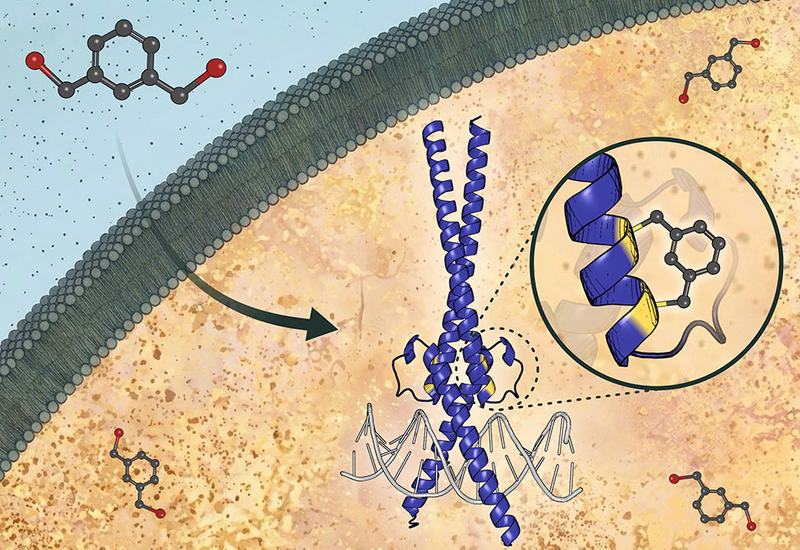
Researchers in the Mason Group at the University of Bath, published in RSC Chemical Biology, addressed this question by applying intracellular covalent cyclization directly to the c-Myc bHLHZip during recombinant expression in E. coli. The bis-alkylating crosslinker 1,3-bis(bromomethyl)benzene was added to the growth medium, penetrating cells and forming i, i + 4 macrocyclic constraints between engineered cysteine pairs at solvent-facing heptad positions across helix one, helix two, and the leucine zipper. Because c-Myc is notoriously insoluble as a recombinant protein, post-purification stapling is impractical; performing the chemistry intracellularly, during active translation, circumvents that barrier entirely. Among the constrained variants tested, the construct stapled within helix two gained measurable α-helical content relative to the unstapled control, and that single, precisely positioned constraint was sufficient to enable sequence-specific E-box DNA binding in the complete absence of Max. Notably, the CD spectrum of the stapled variant bound to E-box DNA does not resemble the canonical Myc–Max coiled-coil architecture, revealing that a non-native but functional conformational state can support sequence-specific DNA recognition.
The finding reframes a long-standing assumption: the apparent undruggability of c-Myc and related IDPs may reflect not an absence of functional conformations, but the difficulty of accessing those states without the binding partners that normally impose them. Intracellular chemical constraint offers a route to expose those latent folded states, creating new entry points for functional interrogation and ligand discovery across the broader IDP landscape. Full biophysical characterization is available in the original publication.