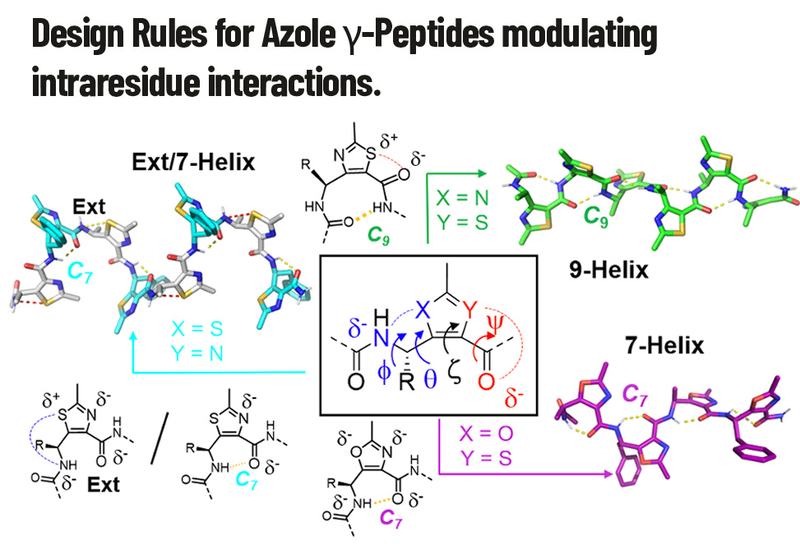
Controlling which helix a foldamer adopts has proven difficult. Most strategies rely on chiral centers, bulky side chains, or metal coordination to bias backbone conformation, and these approaches offer limited flexibility once the monomer is committed to a fold. The thiazole-based γ-amino acid ATC folds reliably into a right-handed 9-Helix stabilized by nine-membered intramolecular hydrogen bonds and an attractive 1,4-S⋅⋅⋅O stereoelectronic interaction between the heterocycle and the carboxamide. Theory predicted that Z-vinylogous γ-peptides could also access a 7-Helix, but no synthetic route to that alternative state had been demonstrated. The challenge was not only to reach the 7-Helix but to understand, at the electronic level, why one heteroatom arrangement favors one fold over another.
Researchers in the Legrand Group at the University of Montpellier, published in Angewandte Chemie International Edition, reasoned that the intraresidue stereoelectronic balance within the heterocycle is the primary conformational determinant, and that rebalancing it through heteroatom permutation or substitution should redirect folding without redesigning the entire scaffold. Permuting the sulfur and nitrogen within the parent ATC thiazole ring yields the isomeric residue ATC*, in which sulfur now engages in attractive S⋅⋅⋅N chalcogen interactions with the adjacent amide, competing directly with the seven-membered hydrogen bond that would otherwise close a C7-turn. DFT and natural bond orbital analyses quantify this competition and reveal an unusual left-handed stretched helix with alternating hydrogen-bonded and non-hydrogen-bonded residues, confirmed by microcrystal electron diffraction of an ATC* octamer. Replacing sulfur with oxygen in the oxazole analogue AOC* removes the competing chalcogen interaction, strengthens the C7 hydrogen bond, and drives AOC* oligomers into a regular, continuous left-handed 7-Helix fully characterized by NMR, FT-IR, and circular dichroism.
The work establishes heteroatom identity within the heterocyclic ring as a legible conformational code for azole γ-peptides, enabling deliberate navigation among distinct helical topologies from a shared synthetic platform. The 7-Helix geometry differs from any canonical protein secondary structure, and the authors point toward future comparisons of its biological properties with those of the 9-Helix scaffold, including antimicrobial activity, amyloid inhibition, and organocatalysis.