Non-invasive PET imaging of inflammation requires probes that are target-specific, pharmacokinetically well-behaved, and chemically homogeneous. Nanobodies, the ~14 kDa single-domain antibody fragments derived from camelid heavy-chain-only antibodies, satisfy these demands in principle: their small size, high stability, and C-terminus orientation away from the antigen-binding site make them natural candidates for site-selective functionalization. The obstacle lies in the functionalization itself. Conventional chemical conjugation reacts indiscriminately with accessible residues, yielding heterogeneous mixtures in which payload position, stoichiometry, and binding capacity vary from molecule to molecule. Enzymatic alternatives such as sortase A offer more precision but require high molar excesses of peptide nucleophile and extended reaction times. Compounding the problem, unmodified nanobodies undergo rapid glomerular filtration and non-specific renal reabsorption, so any practical imaging agent must carry both a radiometal chelator and a pharmacokinetic modifier such as PEG, ideally in a single controlled workflow.
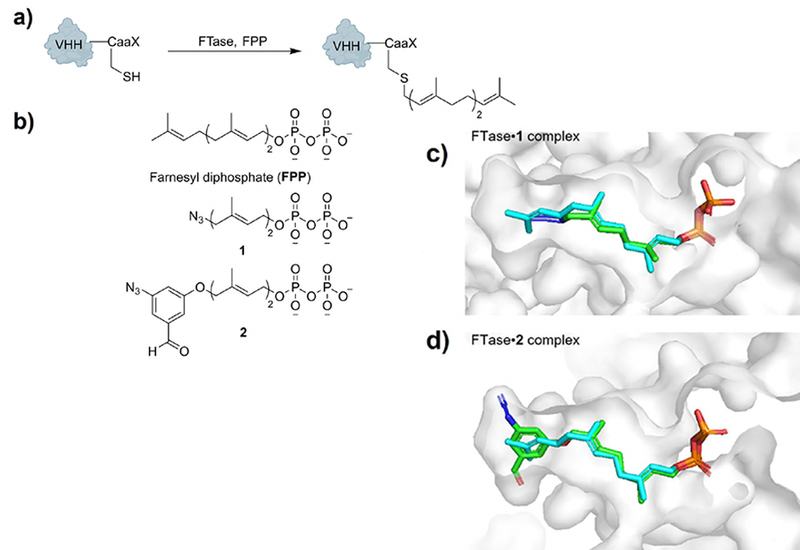
Researchers in the Distefano Group at the University of Minnesota and the Rashidian Group at the Dana-Farber Cancer Institute, published in Angewandte Chemie International Edition, report a chemoenzymatic platform built around protein farnesyltransferase, FTase, that resolves this challenge in one enzymatic step. FTase recognizes a C-terminal CaaX tetrapeptide motif appended to the nanobody and transfers an isoprenoid group from a synthetic farnesyl diphosphate analog onto the cysteine of that motif, forming a stable thioether bond. The key design advance is a trifunctional analog carrying both an azide and an aldehyde handle on the same isoprenoid scaffold. Molecular docking confirmed that this analog adopts a conformation in the FTase active site closely matching that of the natural substrate. Once the dual-handle intermediate is installed on the nanobody, strain-promoted azide-alkyne cycloaddition connects the deferoxamine chelator for 89Zr radiolabeling, while an inverse electron demand Diels-Alder reaction attaches a PEG chain of defined molecular weight through the aldehyde site. The sequential orthogonality of these reactions eliminates cross-reactivity and delivers well-defined, dual-labeled constructs at low micromolar substrate concentrations.
Applied to nanobodies targeting CD11b on myeloid cells and CD45 on all leukocytes, the strategy produced 89Zr-labeled, PEGylated probes that enabled high-contrast PET imaging of immune organs and localized inflammation in a murine complete Freund's adjuvant model. PEG size emerged as a tunable parameter governing renal clearance kinetics and imaging time windows. The platform's compatibility with any protein bearing a C-terminal CaaX motif and its near-quantitative conversions under mild aqueous conditions position it as a broadly applicable route to chemically defined nanobody-based imaging agents for inflammation and other immune-mediated diseases.