Thioamides, backbone modifications in which a carbonyl oxygen is replaced by sulfur, occupy an unusual niche in chemical biology: minimally perturbing by structural metrics yet electronically distinct from ordinary amide bonds in ways that alter hydrogen-bond donor and acceptor strength, rotational rigidity, and spectroscopic behavior. Their promise as biophysical probes of protein folding and aggregation has long been clear, but realizing it in full-length proteins requires native chemical ligation, NCL, of thioamide-containing peptide fragments with expressed protein domains. Prior activation strategies, particularly acyl azide routes, delivered isolated yields rarely above 30%, limiting experiments to dilute or substoichiometric mixtures of modified protein. Studying cooperative β-sheet networks, or following α-synuclein, αS, aggregation with fully thioamide-containing monomer, remained out of reach.
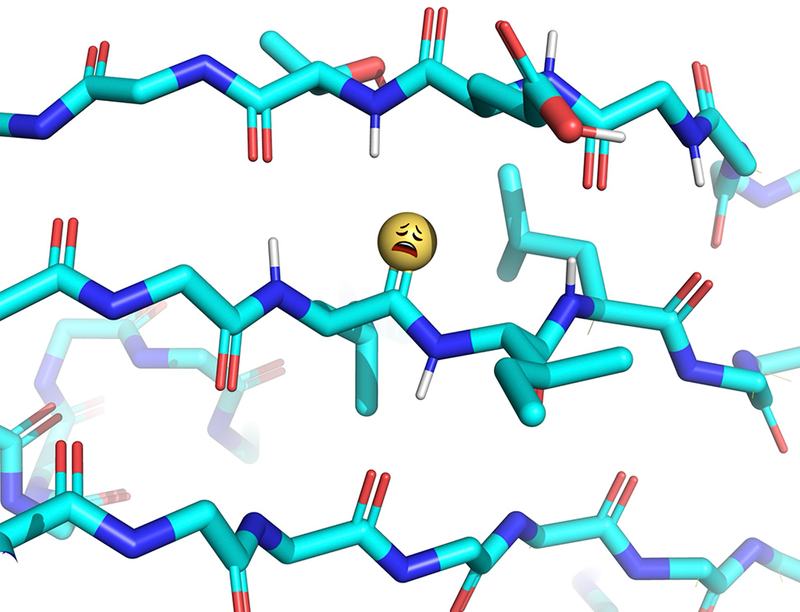
Researchers in the Petersson Group at the University of Pennsylvania, published in Biochemistry, compared two C-terminal acyl hydrazide activation strategies, Knorr pyrazole formation with acetylacetone and the established acyl azide route, for generating reactive thioesters compatible with thioamide-containing peptide fragments. A key concern was whether the nucleophilic thioamide sulfur would react off-pathway with the diketone reagent, causing S-to-O exchange or hydrolysis. The Knorr pyrazole route proved clean: conversion of the acyl hydrazide to the thioester intermediate was complete within three hours, and subsequent ligation of the GB1 N-terminal fragment proceeded to greater than 92% conversion. The scale-up enabled by either route provided sufficient material, for the first time, to conduct homonuclear NMR studies of GB1 and aggregation kinetics experiments with pure thioamide αS. A thioamide at Leu5 in the four-stranded β-sheet of the GB1 B1 domain lowered the melting temperature by 7.5 °C, and 1H–1H TOCSY spectra revealed broad reorganization of the folded structure rather than localized perturbation. For αS carrying a thioamide at Leu8, the time to half-maximal thioflavin-T signal increased nearly fivefold at 100% modified monomer, with gel analysis pointing toward amorphous rather than fibrillar aggregates.
These results establish that a single-atom O-to-S substitution can propagate through a cooperative hydrogen-bonding network with consequences far exceeding those seen in isolated β-hairpin models, and that the N-terminal region of αS plays a larger role in fibril formation than its absence from most cryo-EM and solid-state NMR reconstructions would imply. The improved NCL platform sets the stage for systematic thioamide scanning of amyloid-forming sequences and opens new avenues for using backbone modifications as mechanistic probes where material quantity has historically been the limiting constraint.