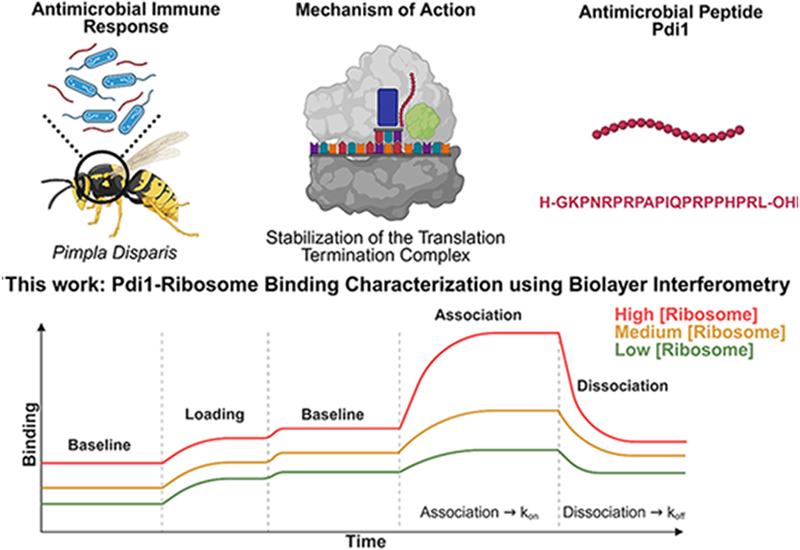
Type II proline-rich antimicrobial peptides, PrAMPs, kill Gram-negative bacteria by blocking translation termination rather than by disrupting membranes, a mechanism that sidesteps most classical resistance pathways. The central assumption is that these peptides must linger inside the ribosomal nascent peptide exit tunnel long enough to sequester release factors and deplete the cellular supply of this essential protein. Yet no biophysical assay had ever measured the binding kinetics of a Type II PrAMP directly, leaving medicinal chemists without a rational filter for structure–activity work. Fluorescence anisotropy, the only available approach, requires ribosome concentrations exceeding 10 µM to approach saturation, a demand that stalls high-throughput screening before it begins. Without kinetic data, the field could not determine whether potency correlates with affinity, with residence time, or with both.
Researchers in the Moore Group at the University of Illinois Chicago, published in ACS Chemical Biology, designed a biolayer interferometry, BLI, assay to interrogate the interaction between the ribosome and Pdi1, a Type II PrAMP from Pimpla disparis that rivals synthetic optimized apidaecins in potency. The key design challenge was geometric: cryo-EM structures show that the peptide N-terminus sits more than 50 Å from the tunnel aperture when bound. To bridge that distance without occluding the binding site, the team conjugated a 24-unit poly(ethylene glycol) linker to the peptide N-terminus on resin, placing a biotin handle beyond the tunnel entrance and allowing the streptavidin biosensor to anchor the peptide while the ribosome associates freely. This single on-resin biotinylation step integrates with automated SPPS, compressing reporter-peptide preparation to one reaction. At a maximum ribosome concentration of just 1 nM, the assay resolved a picomolar dissociation constant for wild-type Pdi1 and measured a slow off-rate that translates to a ribosomal residence time of roughly 24 minutes.
The work delivers the first kinetic portrait of a Type II PrAMP at the ribosome and reframes the design objective: prolonging tunnel residence time emerges as a more decisive driver of antibacterial activity than binding affinity per se. The resource-conservative BLI platform, operable at picomolar ribosome concentrations, opens a practical route to screen synthetic PrAMP derivatives at throughput that fluorescence anisotropy cannot match, and unexpected functional divergence within the conserved C-terminal pharmacophore hints at mechanistic complexity that future structural studies will need to resolve.