Tryptophan Quenches All

Reflecting work in the Vendrell Lab

Published here October 15, 2026

A general strategy towards multicolor fluorogenic peptides for wash-free bioassays

Man Sing Wong, Lorena Mendive-Tapia, Utsa Karmakar, Lovelesh Vashist, Zandile Nare, Karolina Tokarczyk, Kohei Iijima, Kazuya Kikuchi, Syed Ali Abbas Abedi, Xiaogang Liu, Marc Vendrell

Nature Chemistry 2026. https://doi.org/10.1038/s41557-026-02228-0

View Original Publication


Fluorogenic probes that light up only upon target engagement promise cleaner, faster bioassays than always-on dyes, which demand washing steps to achieve adequate signal-to-noise ratios. Fluorogenic amino acids, FgAAs, are especially attractive because they can be woven directly into peptide sequences via standard solid-phase chemistry, placing the switch right at the binding interface. Yet multicolor FgAAs built from modern, high-brightness fluorophore scaffolds have remained out of reach for two compounding reasons: no intramolecular quenching moiety with broad applicability across different fluorescent cores had been identified, and computational tools to predict the operative quenching mechanism were absent. Without both, each new fluorophore color required independent empirical discovery, and pre-formed fluorogenic dyes reported to date suffer from limited brightness that compromises performance in cell experiments.

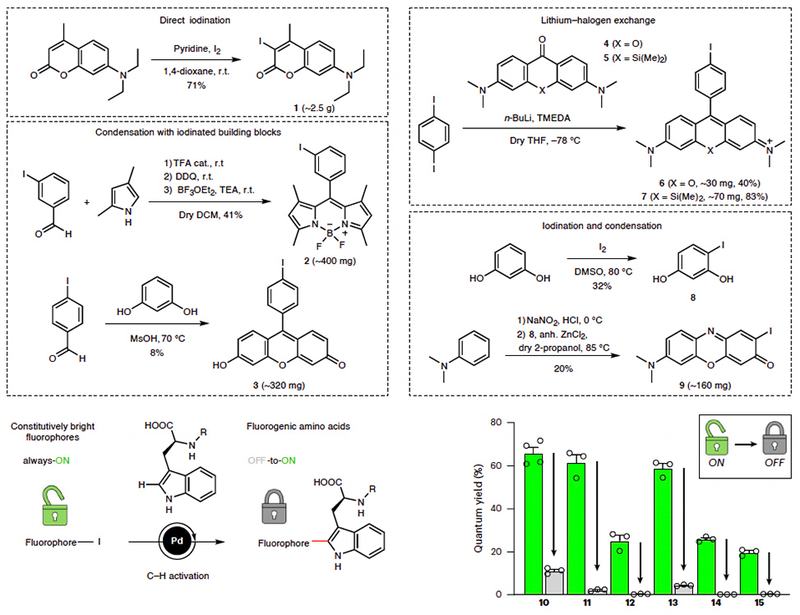
Researchers in the Mendive-Tapia and Vendrell Groups at the University of Edinburgh and the Liu Group at Nanyang Technological University, published in Nature Chemistry, reasoned that tryptophan, already present in nature as an electron-rich aromatic, could serve as a universal quenching partner if coupled directly to a fluorophore rather than tethered at distance. The team forged C–C bonds between the indole C2 position of tryptophan and iodinated fluorophore precursors via palladium-catalysed C–H activation, producing compact FgAAs in which quencher and fluorophore share a covalent bond, enabling wash-free bioassays. The authors note that this synthetic strategy could in principle be applicable to a broad range of fluorescent structures by accessing their aryl iodinated precursors, a generality supported in part by computational evidence alongside experimental synthesis of key scaffolds.

As proof of concept, the team built fluorogenic peptides targeting human PD-1 immune-checkpoint receptors; to the best of the authors' knowledge, no fluorogenic probe for human PD-1 had previously been reported. Lead peptide 36 bound PD-1 by surface plasmon resonance and enabled wash-free imaging of activated T cells, while a screen of nine immune-targeting drugs identified avasimibe as a candidate modulator of PD-1 expression, a connection the authors describe as previously undescribed. Full photophysical and cellular imaging data are in the original publication.

Author

Dr. Liu Xiaogang, is an Associate Professor at the School of Chemistry, Chemical Engineering and Biotechnology, Nanyang Technological University, NTU, Singapore. He received his Ph.D. from the University of Cambridge in 2014 and subsequently worked as a researcher at the Singapore-MIT Alliance for Research and Technology, SMART, before joining the Singapore University of Technology and Design, SUTD, as an Assistant Professor in 2017. He moved to NTU in 2025, where he leads the Photon Emission and Reactivity Laboratory, PEARL. His research focuses on understanding the fundamental photophysical mechanisms of organic fluorophores and translating these insights into molecular design principles for advanced fluorescent probes and bioimaging applications. By integrating quantum chemical calculations with experimental investigations, his group seeks to establish predictive structure–property relationships to guide the rational design of functional molecules. He has received several recognitions, including the 2022 Shimadzu–Singapore National Institute of Chemistry Industry Award and the 2025 Asia Core Program Lectureship.

Author

Prof. Marc Vendrell began his independent career at the University of Edinburgh in 2012 as an Academic Fellow to bridge Chemistry and Medicine through the development and translation of chemical probes for biomedical imaging and drug discovery. Since 2020, he holds a Personal Chair of Translational Chemistry and Biomedical Imaging and leads the IRR Chemistry Hub at the College of Medicine and Veterinary Medicine, one of the first hubs for collaborative “Chemistry in Medicine” research. His group has pioneered activatable fluorophores, fluorogenic amino acids and optical imaging probes with applications in high-resolution biological imaging, immune-cell tracking, clinical diagnostics and translational medicine. Their discoveries have led to 10 licensed and commercialised research-use-only technologies, and some observational clinical studies in several hospitals across Europe. He is co-inventor of 15 patents and has established major collaborations with clinical teams, biotech companies and global pharmaceutical partners in Europe, USA and Asia. Prof. Vendrell has received >£12M funding as PI, with several ERC and EIC grants, and numerous distinctions, including Fellow of the Royal Society of Chemistry, 2017, Marcial Moreno Lectureship, 2018, FLIER Fellow from the Academy of Medical Sciences, 2019, SRUK Emerging Talent Award, 2019, Bader Prize from the Royal Society of Chemistry, 2023, Daiwa Foundation Award, 2025, and the Research Excellence Award from the Spanish Royal Society of Chemistry, 2026. In 2024, he was elected Fellow of the Royal Society of Edinburgh, the Scottish National Academy.

Tryptophan Quenches All

Author

Dr. Lorena Mendive-Tapia studied Chemistry at the University of Barcelona, Spain, where she obtained her BSc and MSc degrees before completing her Ph.D. in Organic and Medicinal Chemistry in 2017. She was awarded the Enrique Fuentes Quintana Award in 2018 for her work on the post-synthetic modification of peptides using chemoselective C–H arylation methodologies. From 2018 to 2025, she worked at the University of Edinburgh, UK, where her research focused on the development of fluorescent probes for bioimaging, with applications in immune-cell tracking, disease research and drug discovery. She also led the Peptide Unit at the IRR Chemistry Hub, contributing to the development of peptide-based tools for biomedical research and fostering collaborations with academic and industry partners. In 2025, she returned to Spain and joined BCN Peptides, where she currently works as an R&D Project Manager, overseeing the development of peptide-based active pharmaceutical ingredients, APIs.