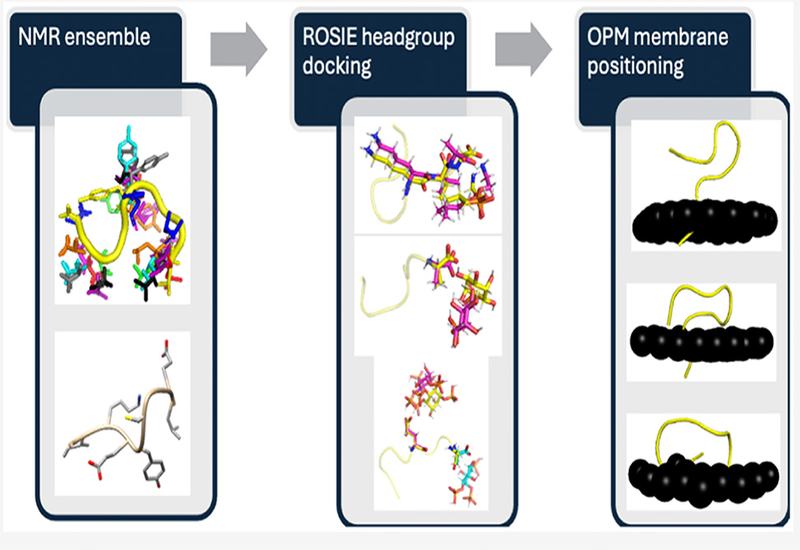
Tyrosine residues are recognized contributors to membrane association, yet treating every tyrosine as functionally equivalent ignores the residues flanking it. The Angiomotin isoforms Amot80 and Amot130 carry a coiled-coil homology domain, the ACCH domain, that interacts with phosphatidylinositol-containing membranes in cancer-relevant signaling contexts. However, the structural basis for this interaction and the role of individual tyrosine residues within the Amot80/130 coiled-coil homology domain remain unclear. Resolving whether each tyrosine-containing segment encodes distinct membrane-recognition behavior, before those segments are placed back into the full-domain context, would illuminate how short local sequences contribute to membrane targeting.
Researchers in the Kimble-Hill Lab at Indiana University School of Medicine, published in Biochemistry, synthesized five tyrosine-containing nonapeptides from native ACCH domain sequences and characterized their membrane interactions using tyrosine absorbance spectroscopy, solution NMR, and computational docking. In these studies, a red shift was taken to suggest that tyrosine had an increased tendency to bury within a hydrophobic region, whereas a blue shift was taken to suggest interaction with a more hydrophilic region. However, none of the ensemble docking results were suggestive of peptide affinity to lipid head groups. These findings suggest that selective membrane targeting by the ACCH domain arises from localized sequence features that integrate proximity between basic residues and lipid head groups and structural positioning at the membrane interface, with local sequence context governing selective tyrosine partitioning.
These findings suggest that selective membrane targeting by the ACCH domain arises from localized sequence features that integrate proximity between basic residues and lipid headgroups and structural positioning at the membrane interface. The authors propose that this sequence-level framework could inform peptide-based membrane targeting in cancer-relevant systems, with future work needed to evaluate candidate peptides in full nanocarrier constructs where linker chemistry, ligand density, and intracellular routing can be assessed in parallel.