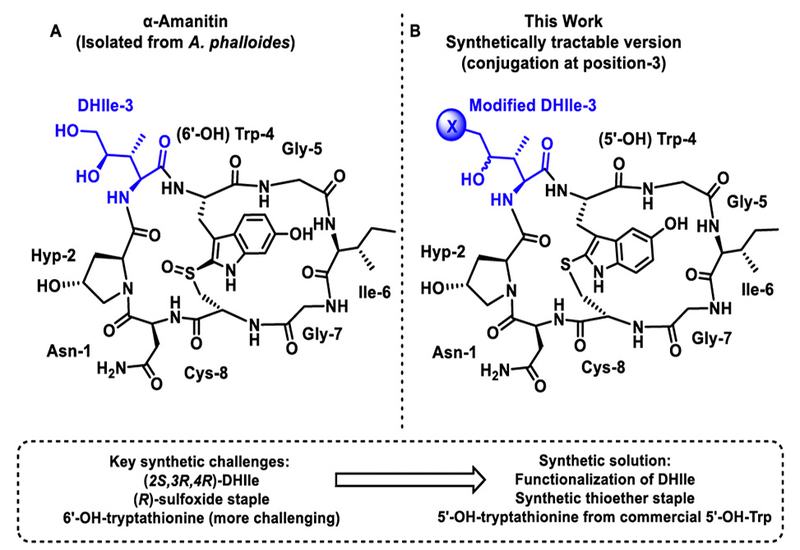
α-Amanitin, the bicyclic octapeptide toxin from Amanita phalloides, kills cells by arresting transcription rather than replication, which means it targets quiescent tumor cells that escape conventional antibody–drug conjugates, ADCs. That mechanistic distinction has driven clinical interest: Heidelberg Pharma's HDP-101, a synthetic amatoxin ADC, is in first-in-human trials. Yet two obstacles limit the payload class. α-Amanitin is a potent hepatotoxin, transported into liver cells by the organic anion transporter OATP1B3, and dihydroxyisoleucine at position-3 of the macrocycle is thought to mediate that uptake. Because dihydroxyisoleucine is chemically inert, attaching linkers requires ester chemistry susceptible to premature hydrolysis. Synthetic routes to δ-substituted analogs existed only on paper, leaving the entire δ-position of this critical residue unmapped.
Researchers in the Perrin Group at the University of British Columbia, published in J. Med. Chem., built on a recently developed scalable dihydroxyisoleucine synthesis to probe that unexplored δ-position systematically. Starting from a proline-catalyzed Mannich reaction, the team prepared a bromo-lactone intermediate as a versatile synthetic node, converting it via nucleophilic displacement into analogs bearing fluoro, azido, amino, mercapto, methylthio, and disulfide groups, each confirmed by single-crystal X-ray diffraction. The resulting NHS esters were incorporated into a monocyclic heptapeptide precursor by solid-phase coupling, then macrolactamized to furnish eleven new amatoxins. Cytotoxicity profiling revealed a chemically sharp stereoelectronic rule: two diastereomers identical except at the γ-hydroxyl showed equipotency and complete inactivity respectively, establishing that hydrogen-bond geometry at that position is non-negotiable. The δ-thiol analog A9 and the δ-amino analog A7 each showed reduced OATP1B3-mediated uptake relative to α-amanitin while retaining near-native cytotoxicity, and conjugating each to trastuzumab yielded HER2-targeting ADCs with IC50 values reaching the sub-picomolar range for the best construct.
These results deliver the first structure–activity map of the dihydroxyisoleucine δ-position in any amatoxin, establishing that the site tolerates functional diversification without loss of RNA Pol II-mediated cytotoxicity while providing the reactive handles that linker platforms require. The OATP1B3 selectivity data point toward a path for reducing the hepatotoxicity that has long shadowed this payload class. Full synthesis protocols, cytotoxicity tables, X-ray structures, and ADC characterization data are available in the original publication.