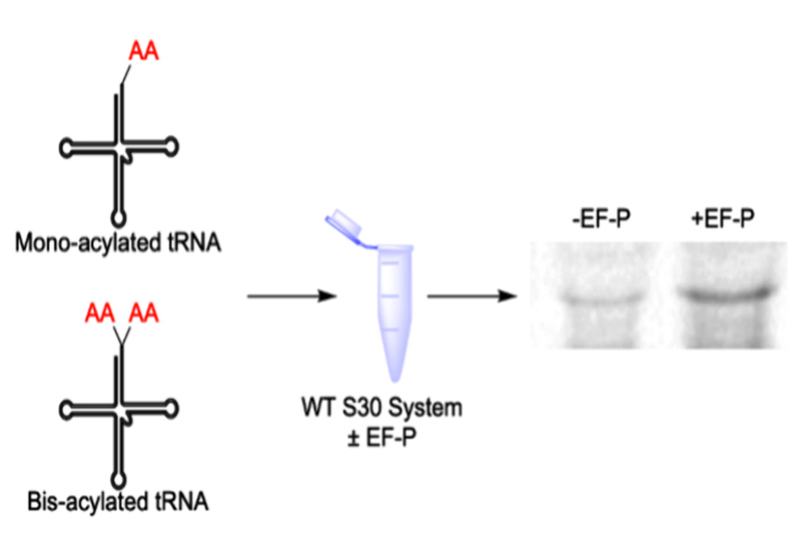
Expanding the genetic code beyond the 20 canonical amino acids is a powerful strategy for engineering proteins with new chemistry, but the ribosome did not evolve to accommodate structurally unusual residues. Cyclic dipeptides are particularly demanding substrates: their conformational rigidity can often slow peptide bond formation, stall the ribosome, and reduce suppression yields to a fraction of those seen with canonical α-L-amino acids. One workaround, loading two copies of a noncanonical residue onto a single tRNA to create a bisaminoacylated tRNA, has previously boosted yields for smaller, less constrained analogues. For bulky cyclic dipeptides, however, the double payload can inhibit incorporation rather than help it, a counterintuitive failure mode whose structural basis presumably reflects their significant bulk. A potential remedy had remained unclear until a recent publication appeared.
Researchers in the Hecht Group at Arizona State University, published in ACS Chemical Biology, systematically probed how elongation factor P, EF-P, modulates this behavior across conformationally constrained cyclic dipeptide analogues differing in ring substitution and stereochemistry. Each analogue was loaded onto yeast suppressor tRNAPhe as both a mono- and bisaminoacylated species and incorporated via nonsense codon suppression in an in vitro transcription/translation system. Without added EF-P, bisaminoacylated tRNAs carrying cyclic dipeptides produced similar or lower yields than their monoaminoacylated counterparts, a pattern not seen with the smaller L-phenylalanine control. The authors attribute this to steric interference: two bulky, conformationally rigid residues on a single tRNA impede accommodation at the peptidyltransferase center. Adding 1 μM fully modified E. coli EF-P reversed this picture. Because EF-P stabilizes the P-site tRNA and promotes peptide bond formation, bisaminoacylated tRNAs proved disproportionately responsive to its action, with yield gains that varied with subtle structural changes, including the absolute stereochemistry of a single methyl group. EF-P therefore senses local analogue geometry rather than simply rescuing any stalled ribosome indiscriminately.
These findings reframe EF-P as a precision complement to bisaminoacylated tRNA strategies for genetic code expansion: where a bulky noncanonical residue would otherwise self-sabotage by loading twice onto the same tRNA, exogenous EF-P converts that liability into a translational advantage. The results open a path toward higher-yielding incorporation of conformationally constrained amino acid analogues using native ribosomes, and they point toward further gains through tRNA engineering optimized for EF-P recognition.