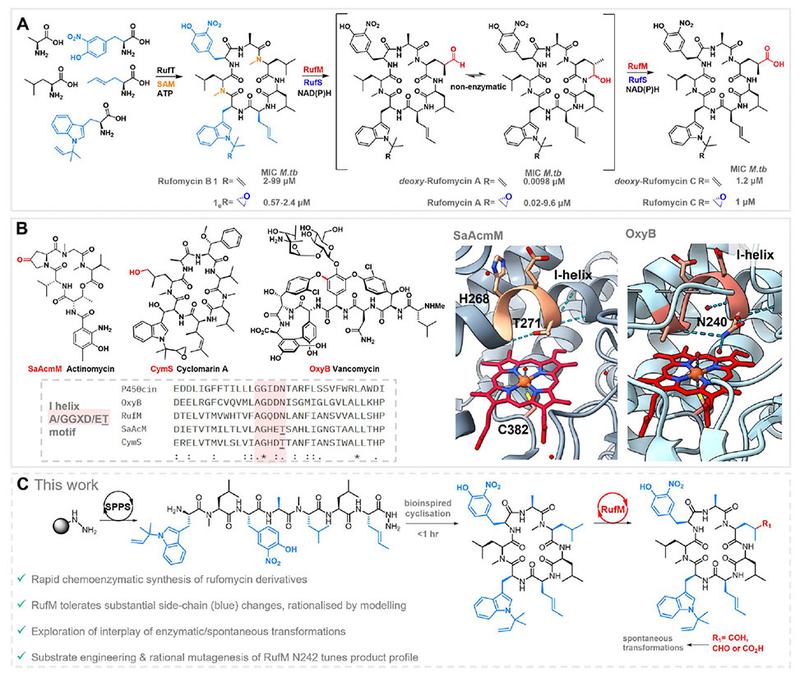
Biosynthetic cytochrome P450 enzymes, CYPs, perform some of the most selective C–H bond activation chemistry in nature, yet they remain poorly understood because accessing their structurally complex substrates is a persistent obstacle. Rufomycins are antimycobacterial cyclic heptapeptides biosynthesized by Streptomyces atratus, and their biological potency depends on sequential oxidation of an N-methyl-L-leucine residue by the tailoring CYP RufM. This multi-step transformation produces several derivatives: an alcohol, an aldehyde that equilibrates with a cyclic hemiaminal and an enamine, and a carboxylic acid, with the aldehyde intermediate carrying the greatest antimycobacterial activity. Sourcing sufficient substrate from bacterial culture to study RufM's mechanism and substrate scope had previously confined researchers to small-scale experiments with unreliable supply, leaving critical questions about the enzyme's substrate tolerance and its unusual active-site architecture unanswered.
Researchers in the Barry Group at King's College London, published in Chemical Science, applied their recently developed acyl azide mediated bioinspired peptide cyclization method to synthesize rufomycin B and a library of 17 cyclic peptide analogues in near-quantitative conversion, replacing dependence on bacterial extracts with a rapid, scalable chemical route. Scaled-up reactions with synthetic substrate allowed time-resolved LC-MS monitoring that captured transient intermediates, including a previously uncharacterized enamine product, and revealed for the first time that the alcohol intermediate is released by RufM before rebinding for further oxidation. Screening the analogue library showed that the biosynthetically expensive non-proteinogenic residues are not required for RufM activity or antimycobacterial potency, and that substituting more polar residues at a remote position redirects oxidation to a secondary leucine site, yielding a novel diol product. Mutagenesis of N242, an asparagine that replaces the canonical I-helix threonine, showed that the N242L variant selectively accumulates aldehyde and hemiaminal intermediates rather than over-oxidizing to the carboxylic acid, and that pairing N242L with the epoxidizing enzyme RufS in a one-pot cascade produces the most biologically active oxidation state of a rufomycin analogue.
The work demonstrates that bioinspired cyclization chemistry can transform the study of cyclic peptide tailoring enzymes by delivering substrate libraries on demand. The substrate tolerance data, mutagenesis results, and structural models provide a framework for engineering the rufomycin biosynthetic pathway and for deploying biosynthetic CYPs as late-stage functionalizing biocatalysts in the broader effort to develop antimycobacterial agents against drug-resistant tuberculosis.