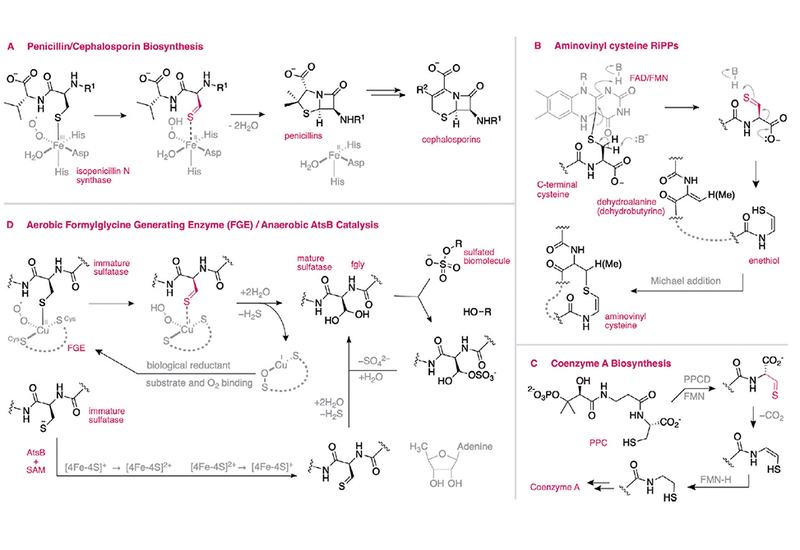
Cysteine thioaldehydes sit at the mechanistic center of several biosynthetic pathways, including the formation of aminovinyl cysteine bridges in ribosomally synthesized and post-translationally modified peptides, RiPPs, the activation of type-I sulfatases via the formylglycine-generating enzyme, FGE, and the assembly of coenzyme A from pantothenate. Yet characterizing these intermediates directly has proved difficult because thioaldehydes are intrinsically unstable, prone to polymerization, and in aqueous solution are rapidly consumed by competing deprotonation and radical pathways. Earlier attempts to generate them by Norrish type-II photolysis of phenacylsulfides were undercut by a rival β-scission pathway that regenerated the parent cysteine thiol, limiting conversion and obscuring downstream reactivity. Without a reliable method for producing cysteine thioaldehydes cleanly in water, the mechanistic proposals underpinning FGE catalysis, azole biosynthesis, and penicillin formation remained inferential.
Researchers in the Myers Lab at the University of Galway and the Fascione and Spicer Groups at the University of York, published in Angewandte Chemie International Edition, show that placing non-conjugating electron-withdrawing substituents on the phenacylsulfide aryl ring, particularly 3,5-bis(trifluoromethyl) and trimethylammonium groups, shifts the excited-state balance decisively toward Norrish type-II fragmentation by stabilizing the n→π* triplet state relative to the π→π* triplet. In aqueous buffer, this delivers cysteine enethiolate and cysteine isothiazolone as the primary products, the two being interconvertible with a reductant or oxidant. The team then used this platform to map the reactivity network of cysteine thioaldehydes: at low pH, enethiols undergo cyclocondensation to thiazoles; in the absence of buffer, hydrolysis to formylglycine competes with trapping by dihydrogen sulfide; and nucleophilic n→π* participation by the proximal backbone carbonyl diverts the thioaldehyde toward peptide oxazoles. An alanine scan of the FGE consensus-sequence pentadecapeptide reveals that the arginine side-chain guanidinium group and the peptide's secondary structure critically gate the hydrolysis pathway, with guanidinium hydrogen-bonding lowering the thiocarbonyl hydration barrier by approximately 2 kcal/mol in DFT models.
These findings recast cysteine isothiazolones as isolable, reducible masked thioaldehydes and demonstrate that the biosynthetic oxidation-then-cyclocondensation route to peptide azoles is chemically viable, complementing the canonical ATP-driven cyclocondensation-then-oxidation sequence. For researchers studying RiPP biosynthesis, sulfatase engineering, or FGE-based aldehyde-tag bioconjugation, the aqueous reactivity map reported here provides a framework for understanding how nature channels this reactive intermediate toward a single productive outcome.