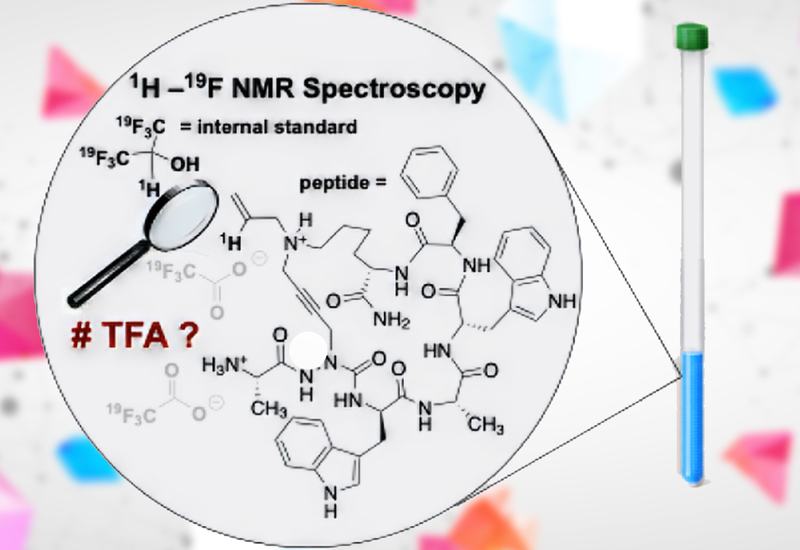
Trifluoroacetic acid, TFA, touches nearly every peptide made by Fmoc chemistry: it strips protecting groups, cleaves resin, and pairs ions during HPLC purification. The result is that most synthetic peptides reach the biologist as TFA salts of uncertain composition. That uncertainty matters because trace TFA has been reported to alter peptide conformation, contribute to cytotoxicity, and complicate conformational analysis by IR spectroscopy. Existing quantification methods, including FT-IR, ion chromatography, capillary electrophoresis, and 19F NMR with a gravimetric internal standard, share a common weakness: they depend on accurate weighing of a peptide sample before measurement. Hygroscopic salts, submilligram quantities, and precious intermediates make that weighing step a genuine source of error and, sometimes, simply impractical.
Researchers in the Lubell Group at Université de Montréal, led by Ph.D. candidates Nassim Maarouf-Mesli, and Charity D. Yongo-Luwawa published in the Journal of Organic Chemistry, developed a non-destructive NMR approach that eliminates the weighing requirement by correlating 1H and 19F signal integrations within the same spectrum. The core idea draws on a precedent in betaine chemistry, where 19F and 13C NMR correlation inferred trifluoromethanesulfonate content without a mass measurement. Here, hexafluoroisopropanol, HFIP, and trifluoroethanol, TFE, serve as volatile, water-soluble fluorinated internal standards added in known molar ratios to a D2O solution of the peptide. Because both the internal standard and TFA contribute resolved signals in the 19F spectrum, their ratio is measured cleanly; the 1H integration of a well-resolved peptide proton then anchors the peptide quantity without any mass input. Benchmarking across a temperature range from 298 to 333 K revealed that residual H2O systematically overlaps with either the HFIP methine heptuplet or the TFE methylene quartet, and three integration correction strategies address these overlaps by taking half-integrals, mirroring the water peak symmetrically, or subtracting a peptide-proton contribution from the internal standard region.
A practical, nondestructive tool for TFA salt composition assessment has broad relevance across peptide science, from pharmaceutical quality control to routine characterization of antimicrobial peptides and macrocyclic drug candidates purified by HPLC. The method requires only a standard high-field NMR instrument and two commodity fluorinated alcohols, placing accurate counterion accounting within reach of any laboratory that synthesizes peptides. Full protocols, relaxation time-tables, and benchmarking against capillary electrophoresis by the Waldron Lab are available in the original publication.