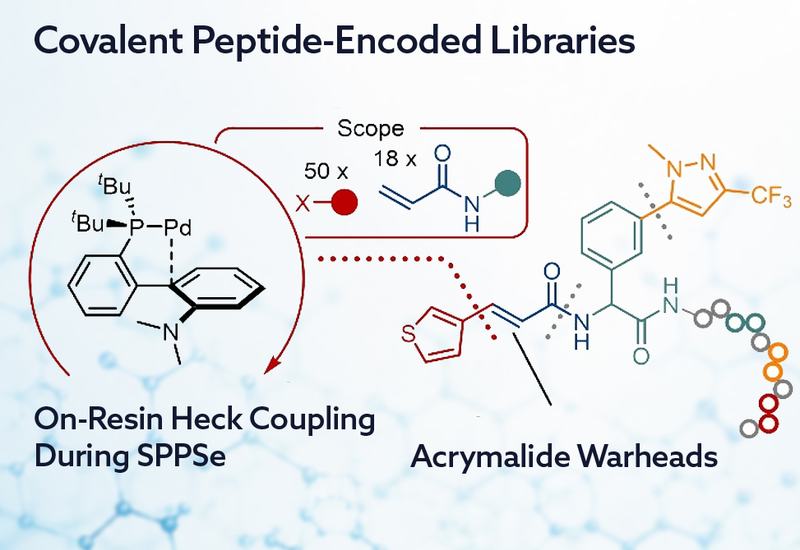
Peptide-encoded libraries, PELs, let chemists survey large expanses of chemical space in a single affinity-selection experiment, yet they had not been used to explore covalent ligands. The missing piece was a reliable way to furnish resin-bound peptides with functionalized covalent warheads during solid-phase synthesis. Intermolecular Heck coupling was a logical fit: it can install diverse aryl groups directly onto acrylamides that then react with target cysteines. But the reaction had resisted translation to resin-bound substrates, where sluggish mass transfer of diffusing aryl halides must be managed under conditions compatible with sensitive peptide side chains. More reactive aryl halides tend toward double arylation, while less reactive ones stall at low conversion, and the reaction requires strict exclusion of oxygen and moisture to avoid dramatically reduced conversion.
Researchers in the Nile Lab at Calico Life Sciences LLC, and the Pentelute Group at the Massachusetts Institute of Technology, published in Chemical Science, address this gap with a covalent peptide-encoded library platform they call coPEL. The key move is leveraging palladium catalysts derived from tBuDavePhos, a phosphine ligand that, to the best of the authors' knowledge, had not previously been used in Heck coupling; they postulate that fine-tuning the steric features of the lower aromatic rings of dialkylbiaryl phosphines is crucial for reactivity, and that the tert-butyl substituent potentially further accelerates the migratory insertion step. Because the acrylamide warhead reacts with piperidine, all encoding steps after acrylation used DBU as base. Screened against wild-type EGFR tyrosine kinase as a model target, the coPEL yielded original low-micromolar covalent inhibitors.
The authors conclude that intermolecular on-resin Heck coupling is now a practical tool for solid-phase peptide synthesis and expands accessible chemical space for covalent ligand discovery. Functionalized acrylamides offer tunable reactivity and potential for improved potency and selectivity, and ongoing efforts are applying the coPEL platform to additional targets beyond this proof-of-concept demonstration. Full substrate scope, library design, selectivity profiling, and inhibitor characterization data are available in the original publication.