Peptide Publications Archive
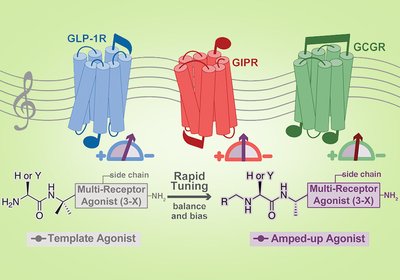
Tuning Incretin Balance
Kumar Lab
A single chemical edit at the N-terminus of a GLP-1/GIP/glucagon multiagonist can shift receptor potency balance by orders of magnitude, selectively suppress β-arrestin recruitment, or …
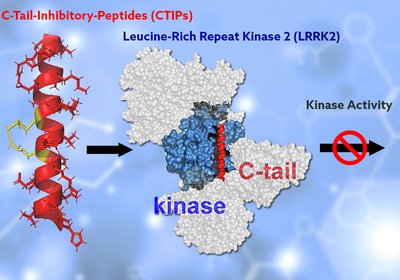
Stapling LRRK2
Kennedy Lab
Hydrocarbon-stapled peptides that mimic the C-terminal helix of LRRK2 can penetrate cells, bind the kinase directly, and suppress its hyperactivation without triggering the mislocalization side …
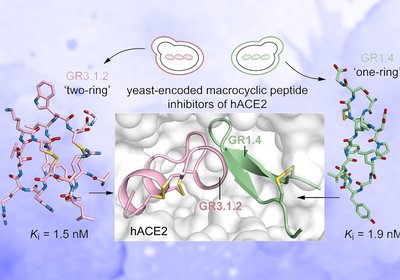
Yeast Finds Inhibitors
Angelini Lab
Yeast display technology, long used to evolve antibodies, can now rapidly surface macrocyclic peptide inhibitors of human angiotensin-converting enzyme 2 with potencies in the low-nanomolar …
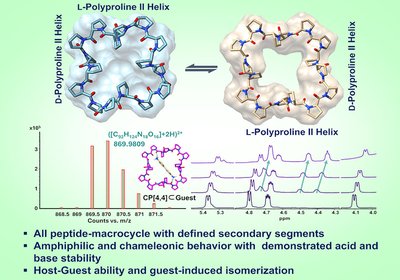
Chameleonic Proline Rings
Palma Lab
A new family of all-peptide macrocycles built from alternating L- and D-proline tetramers flips between two distinct conformations depending on solvent, solves long-standing functionalization challenges …
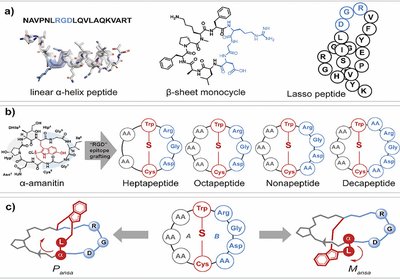
Ansamers Target Integrins
Yao Lab
Bicyclic peptides derived from the amanitin scaffold can exist as non-interconvertible conformational isomers called ansamers, and the two mirror-like forms can differ by orders of …
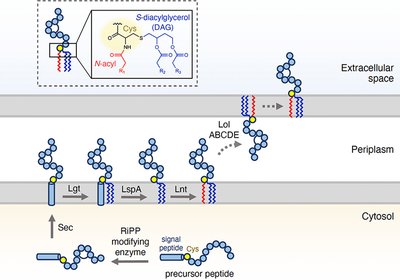
Lipid-Hijacking RiPPs
van der Donk Lab
Bacteria already possess a well-oiled machinery for anchoring lipoproteins to their membranes. A new study reveals that a family of ribosomally synthesized peptides has co-opted …
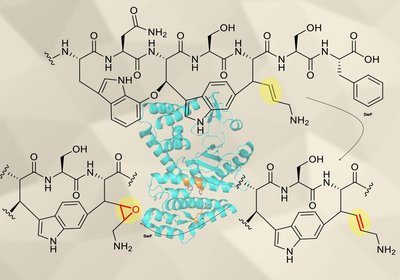
DarF Decoded
Phan Lab
An enzyme in the darobactin biosynthetic pathway had been classified as a protease for years. New biochemical evidence shows it is actually an α-ketoglutarate-dependent oxidase …

Porous Collagen Crystals
Merg Lab
Collagen-mimetic peptides are renowned for triple-helix rigidity, but no one had channeled that rigidity into a porous crystalline framework. Now, by appending a single alkyl …
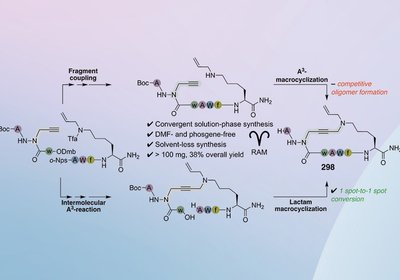
Scalable Azapeptide Macrocycles
Lubell Lab
A convergent solution-phase strategy for a potent macrocyclic azapeptide CD36 modulator sidesteps preparative chromatography entirely, delivering 100 mg of >99%-pure material by swapping an oligomer-prone …
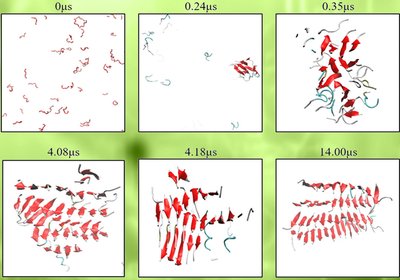
Hairpins Hold the Key
Hall, Radford, and Brockwell Labs
A single methionine swap in α-synuclein's N-terminal P1 motif dismantles the β-hairpin architecture that normally launches amyloid fibril formation
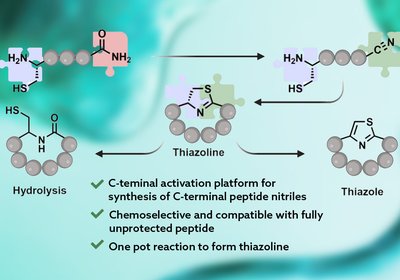
Activating Native Termini
Raj Lab
Thiazoline and thiazole macrocycles embedded in bioactive marine peptides have long required pre-built specialty building blocks that slow synthesis and risk epimerization. A new palladium-mediated …
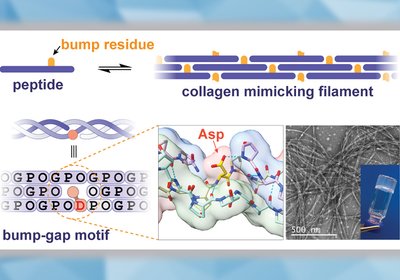
Bump-Gap Filaments
Chenoweth Lab
Natural collagen carries risks of immunogenicity and resists chemical modification, but synthetic collagen-mimetic peptides have struggled to match its continuous, mechanically robust fibrillar architecture. A …

Labeling Serine Selectively
Chen Lab
Serine and threonine hydroxyl groups are among the most difficult side chains to modify selectively in complex peptides, yet they govern phosphorylation, glycosylation, and enzyme …

Chaperone Orientation Rules
Gierasch Lab
Three closely related Hsp70 molecular chaperones grip the same model peptides in strikingly different orientations: bacterial DnaK shows no directional preference, human Hsc70 leans toward …
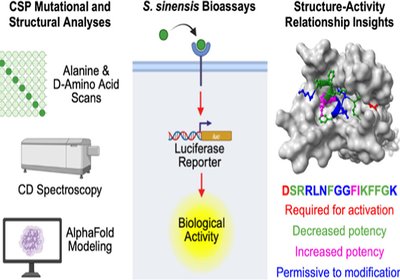
Silencing Strep Signals
Tal-Gan Lab
Streptococcus sinensis is an oral commensal that turns deadly when it reaches the bloodstream, causing infective endocarditis with roughly 25% mortality. A new mutational map …
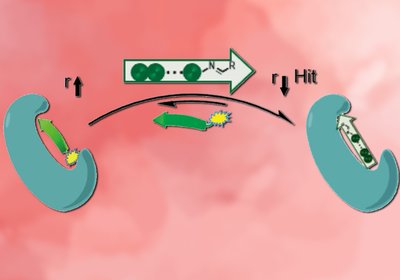
Fragment Capping PDZ
Wilson Lab
β-strand-mediated protein–protein interactions are among the hardest targets in chemical biology, and PDZ domains are notoriously resistant to small-molecule ligands. A dynamic ligation screen against …
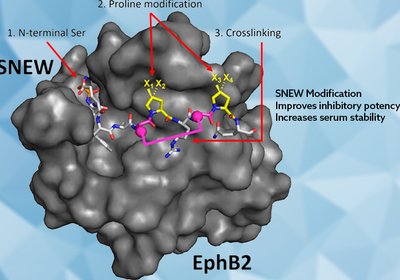
Stabilizing SNEW
Sawyer Lab
The EphB2 receptor drives several cancers, yet its best peptide inhibitor, SNEW, has languished with modest potency and poor serum stability. Swapping its N-terminal serine …
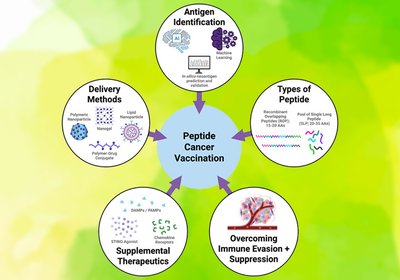
Priming the Attack
Kimmel Lab
No peptide cancer vaccine has yet earned FDA approval, yet the field is converging on strategies that may finally close that gap. A new review …
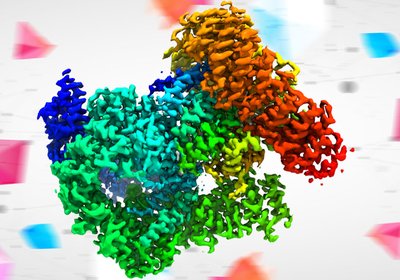
Hunting Huntingtin
Harding Lab
Huntingtin, the protein at the center of Huntington's disease, has long resisted selective chemical interrogation. A new suite of macrocyclic peptide tools now binds it …
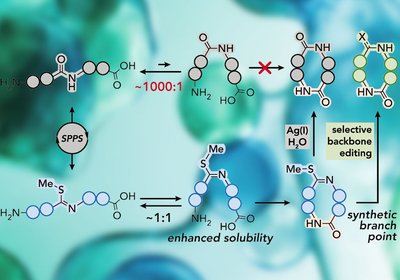
Unlocking Small Macrocycles
VanVeller Lab
Short homochiral peptides routinely defeat macrocyclization attempts, either failing to close the ring or dissolving poorly enough to prevent even trying. A single backbone thioimidate …
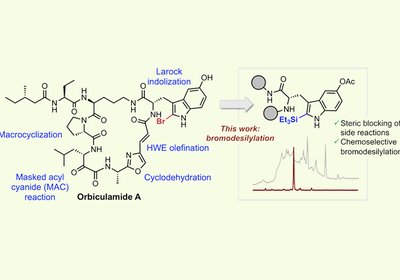
Taming Bromine
Perrin Lab
For 35 years, the marine macrocycle orbiculamide A resisted total synthesis, largely because its 2-bromo-5-hydroxytryptophan residue defeats every conventional bromination strategy. Now, a chemoselective late-stage …
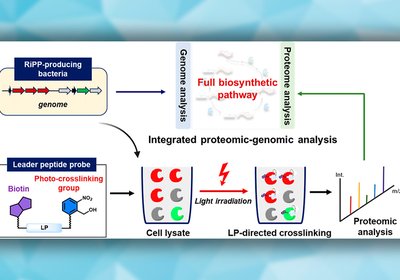
Mapping Hidden Enzymes
Wang Lab
Genome mining reliably maps biosynthetic gene clusters for ribosomally synthesized and post-translationally modified peptides, RiPPs, yet routinely misses enzymes encoded elsewhere in the genome. A …
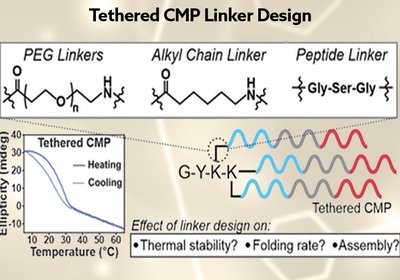
Linkers Shape Collagen
Merg Lab
Covalently tethered collagen-mimetic peptides fold into triple helices and assemble into nanosheets, but how does the linker connecting each strand to its scaffold influence stability? …
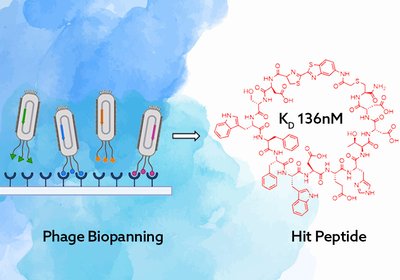
Cornering RhoA G17V
Liu-Hampton Lab
RhoA G17V drives nearly 70% of angioimmunoblastic T-cell lymphoma cases yet has resisted every small-molecule effort for decades. Now, a phage-displayed macrocyclic peptide library yields …